十Christian Japan
Place guide · Hirado & Ikitsuki · Hidden Christian village

Kuroshima Village and Church

World Heritage component

When a domain ranch off Sasebo was opened to settlers, hidden Christians from Sotome came, joined the island's Buddhist temple and prayed in secret before a Kannon they took for Mary. How did a whole island come back to the Church at once?

3 min read7 sources3 pinsVisitingTap any name, place or term to learn moreTimeline

An island that came back together. Kuroshima's hidden Christians settled an old ranch, hid behind a temple, and after the Discovery reported themselves to the priests as a single community, then built one of the largest brick churches in Japan.

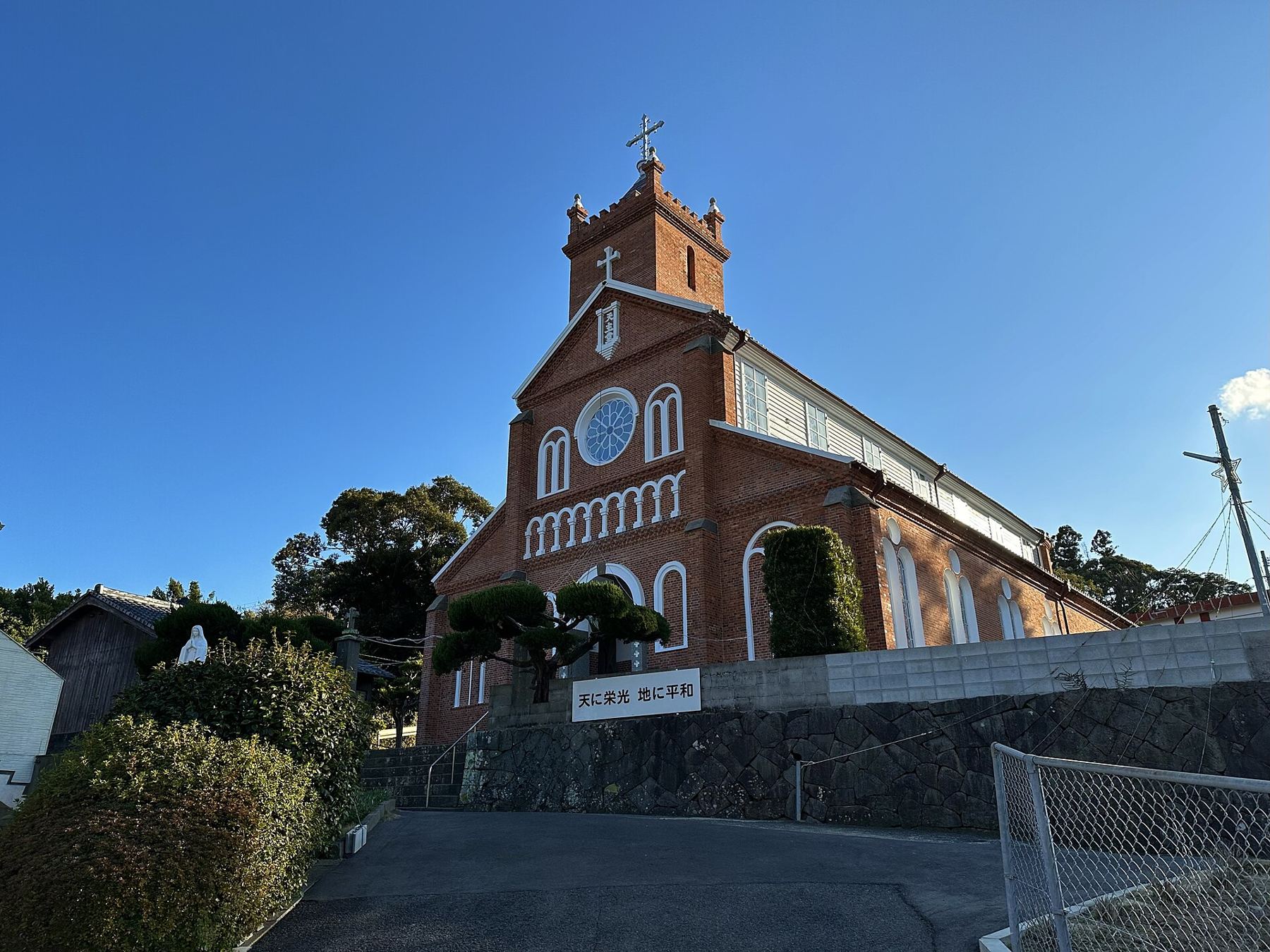
Kuroshima Church, a red brick church with a bell tower among trees
Kuroshima Church, a red brick church with a bell tower among trees.黒島天主堂 (January 2023). そのだ かずき, CC BY-SA 4.0. Commons

In 60 seconds

The place in 8 steps. Each line is footnoted.

  1. 1700s to 1800sSettlers, including hidden Christians from Sotome, come to the Hirado domain ranch on Kuroshima.
  2. 1802The ranch is closed and the land opened for farming; hidden Christians settle at Warabi.
  3. 1865After the Discovery, Kuroshima's leaders travel secretly to Ōura.
  4. 1872The first Mass on the island is said in the house of the Deguchi family.
  5. 1879 or 1880The first church is built in the middle of the island.
  6. 1902Father Marmand's brick church is completed and blessed.
  7. 1998The church is designated an Important Cultural Property.
  8. 2018Kuroshima is listed as a World Heritage component.

A Kannon in the temple

Kōzenji, the island's Buddhist temple, was founded when settlers flooded onto Kuroshima. The hidden Christians among them registered there and went to worship like everyone else. But the prefecture says that before a set up in the main hall they quietly offered their own prayers.

Kuroshima is one of five World Heritage villages chosen to show where hidden Christians moved to keep their communities alive. Here the answer was an old ranch. The prefecture says hidden Christians from across the Nagasaki region heard that settlers were being encouraged to redevelop the former ranch of the Hirado domain, and chose it as a place where they could live alongside the existing village.

1802

The ranch at Warabi

The school guide is precise: horses were raised around the hamlets of Warabi and Tashiro until 1802, when the ranch was closed to make farmland, and hidden Christians moved in from and elsewhere. They built houses on the slopes near the shore and went on praying in secret. the prefecture's heritage site says settlement began in the 18th century; the World Heritage panel says the 19th century.

The old village of Honmura kept apart. Its people prayed at the temple and had little to do with the newcomers. Even in death the newcomers were different: at Shikirimaki, Warabi's graveyard until the 1880s, hidden Christian graves face the opposite way to temple graves.

On the mapFrom Sotome to the ranch
Kuroshima Church, Shitsu Church. Full atlas and pin sources
1865 to 1873

"There are 600 believers"

When news of the Discovery at reached Kuroshima, the island's hidden Christians were overjoyed. Twenty representatives, led by the Deguchi father and son, who served as , crossed to Nagasaki. They told the missionaries, by the prefecture's account: "There are 600 believers on Kuroshima." reported speech, given by the prefecture with "it is said".

They went back many times to learn from the priests, and the priests began to come to the island, crossing the sea at night in disguise. In 1872, while Christianity was still banned, the first Mass on Kuroshima was said in the house of . When the ban was lifted in 1873, the whole community returned to the Catholic Church at once. A stone now marks the Deguchi house as "the place where the faith revived".

Sources: "there are 600 believers"

The World Heritage panel and the 2020 school guide for Sasebo give the official account; the prefecture's heritage site adds the 1880 church and the builder's name. The story of the twenty representatives and the night crossings is told in a prefecture column and carries "it is said".

1879 to 1902

Four hundred thousand bricks

The Deguchi house served as a temporary church until a first church was built in the middle of the island, where everyone could reach it. the World Heritage panel and the school guide give 1879, built by ; the prefecture's heritage site gives 1880, built by the believers with local bamboo and pine.

In 1897 Father of the Paris Foreign Missions Society came to the island. He designed the present church, begun in 1900 and completed and blessed in 1902, with Maeyama Sakichi as builder. It is one of the largest brick churches in Japan. Bricks bought in Sasebo and Arita were landed at Nakiri beach and carried up the slope by the faithful. To save money Marmand had them try firing their own, but the salty red clay made poor bricks, which are thought to have gone where no one would see them. the number of 400,000 bricks is "handed down".

The stone steps and walls in front of the church are those of the first church. At weekly Mass, the prefecture says, a prayer is still offered in atonement for the .

On the mapTo Ōura and back
Kuroshima Church, Ōura Cathedral. Full atlas and pin sources
Today

The island of prayer

Kuroshima is still a Catholic island. Marmand is buried in the Catholic cemetery. The church has a small museum in the former "mon-beya", where children once studied and sisters stayed.

Timeline

The dated story

Every dated event on this page, with its sources. Filter by section.

  1. 1700s to 1800sSettlement of the former Hirado ranch, including hidden Christians (dates Disputed)
  2. 1802Ranch closed; hidden Christians settle Warabi
  3. 1865Kuroshima representatives visit Ōura
  4. 1872First Mass in the Deguchi house
  5. 1873Whole community returns to the Church
  6. 1879First church, by Father Pelu (World Heritage panel)
  7. 1880First church, by the believers (prefecture site)
  8. 1880sCatholic cemetery replaces Shikirimaki graveyard
  9. 1897Father Marmand arrives
  10. 1900Present church begun
  11. 1902Present church completed and blessed
  12. 1998Kuroshima church becomes an Important Cultural Property
  13. 2018World Heritage listing
Atlas

Where it happened

Each pin is a place named on this page. Coordinates come from official prefecture maps, OpenStreetMap or Wikidata, as listed. Rows marked "not yet pinned" have no verified pin.

This placeRelated site
PlaceWhy it matters hereCoordinatesCoordinate source
Kuroshima ChurchMarmand's brick church of 190233.1391534, 129.5370186OpenStreetMap way/418979072
Shitsu Church, SotomeWhere many settlers came from32.84392, 129.70092Wikidata Q11395699
Ōura CathedralWhere Kuroshima's leaders met the priests32.734189, 129.8701625OpenStreetMap way/243003159
Kōzenji, KuroshimaTemple with the Maria Kannon (Tradition)-not yet pinned
Deguchi house siteFirst Mass, 1872-not yet pinned
Name cards

People, places and events

Who and what this page touches. Dashed cards are pages still to come.

Visiting

If you go

Practical details change. Check with the operators before you travel. Churches are places of worship: please follow the visitor manners asked of you.

Read next

Where to go from here

Glossary

Words on this page

Maria Kannon マリア観音
A statue of the bodhisattva Kannon venerated in secret as Mary.
mizukata 水方
The baptiser and leader of a hidden community.
treading on images 絵踏
The test of making people step on an image of Christ or Mary.
Sources

Footnotes

Translations from Japanese sources are ours.

  1. Nagasaki Prefecture World Heritage Division, component panel "7. Villages on Kuroshima Island" (kirishitan.jp), source link
  2. "Nagasaki and Amakusa Hidden Christian Sites" Preservation and Utilisation Committee, 学校教育用補助教材(佐世保市用)[School supplement, Sasebo City edition] (March 2020), pp. 9 to 14, source link
  3. Nagasaki Prefecture, おらしょ こころ旅, "黒島天主堂" (history, data, glossary entry for Marmand, access), source link
  4. Nagasaki Prefecture, おらしょ こころ旅, column "初めてのミサ" (Kawamura Noriko), source link
  5. UNESCO World Heritage Centre, "Hidden Christian Sites in the Nagasaki Region" (no. 1495, 2018), source link
  6. Nagasaki Prefecture, おらしょ こころ旅, column "40万個の煉瓦の話" (Kawamura Noriko), source link
  7. Nagasaki Prefecture tourism (ながさき旅ネット), "教会見学時マナーのご案内," source link
Images

Image credits