Two mats
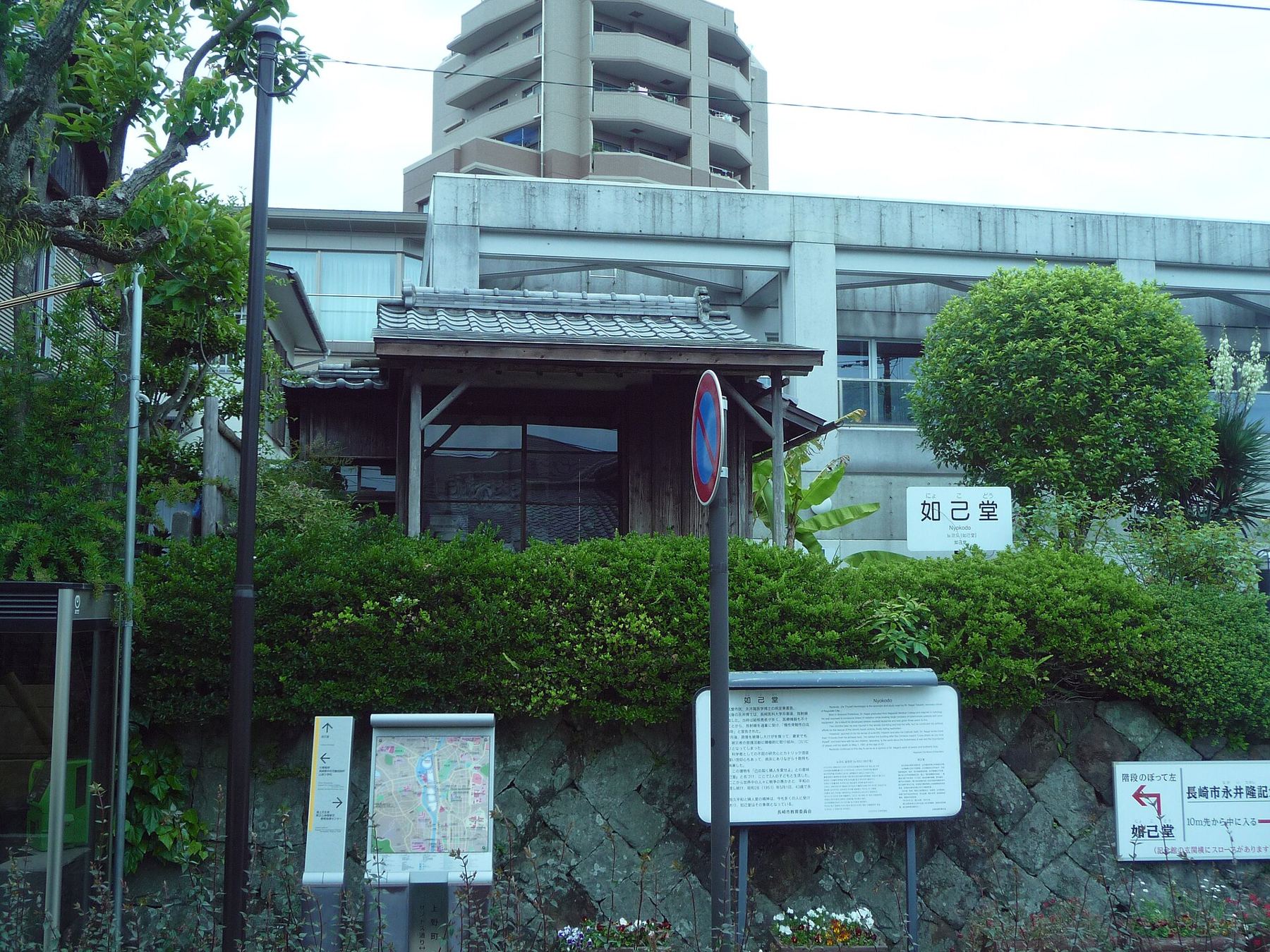
"The Nyokodō where I lie is a house of one room, two mats. Beside my bed one more mat is laid, and that is where Makoto and Kayano live."
wrote those lines in 1948, in Kono ko o nokoshite (Leaving These Children). He had been bedridden since November 1946, with leukaemia caused by years of work with radium, and with the injuries of 9 August 1945. His wife had died in the bombing of their house; his two children had survived because they were out of the city.
In the spring of 1948, as the burned ground of Urakami was turning into barley fields and the first barracks were going up, the people of Urakami and his Catholic friends built him a new home. The official Nagasaki tourism portal remembers who they were: people of Urakami left with nothing by the bomb, and his fellow Catholics. He named it Nyokodō, from the verse "love your neighbour as yourself". He wrote that the people of Urakami loved him as themselves, a sick man far from home, and that he named the house for that and gave thanks for it in prayer.
Sources: two mats
The building, the dates and the quotation all come from the Nagasaki City Nagai Takashi Memorial Museum, which runs the site, and its chronology. The longer life story is on our person page.
The calendar keeper's ground
The museum's front garden holds a stone marking the site of the yashiki, the house of the chōkata, the leader of Urakami's hidden Christian organisation who kept the church calendar. It stood roughly where Nyokodō now is.
Midori's family, the Moriyama, were descendants of that line of , according to the scholar Miwa Chishio. Unverified beyond one scholarly source.
A writer's bed
Everything he needed was within reach of the bed: daily things, manuscript paper, research books, brushes and paints. From this room he wrote The Chain of the Rosary, Leaving These Children and The River of Life, all finished in 1948, and The Bells of Nagasaki, published in January 1949. His last book, , about the Urakami exiles at Tsuwano, was finished here on 22 April 1951.
Visitors came to the door of the hut. came on 18 October 1948. an interview with the museum's director gives the 8th. In August 1950 the film of The Bells of Nagasaki had a preview showing in the front garden. He wrote the words , "love others as yourself", as his testament to his children and to everyone living after him. From this room, the portal says, he kept on encouraging the people of Urakami; Leaving These Children became a film and The Bells of Nagasaki a song still sung today.
Nagai read the bomb as a Catholic. In an extremely influential book he called the victims precious sacrifices, a hansai, a burnt offering, the word Japanese uses for "holocaust", and Catholics in Japan linked the bomb to the sufferings of the Japanese martyrs. Many Japanese philosophers protested at the word.
On 25 April 1951 bleeding in his right shoulder stopped him writing. On 1 May he was taken to the university hospital, where he died at 9:50 that evening. the parish history says he died at Nyokodō; the museum's chronology is more specific.
The children's bookcase
In 1950 Nagai spent his own money on a reading room for children, Uchira no hondana, "our bookcase", to give the children of the ruins something better; people in America sent thousands of books. That May a Japanese resident of Brazil, Miyazaki Takae, visited and backed his idea of a proper children's library. Between 1951 and 1952, 471 Japanese residents of Brazil sent 1,747,188 yen, and with about 400,000 yen from the city the Nagasaki City Nagai Library opened in December 1952. It was renamed the Nagai Memorial Hall in 1969, rebuilt in 1999, and reopened in April 2000 as the Nagasaki City Nagai Takashi Memorial Museum. Nyokodō stands beside it.
