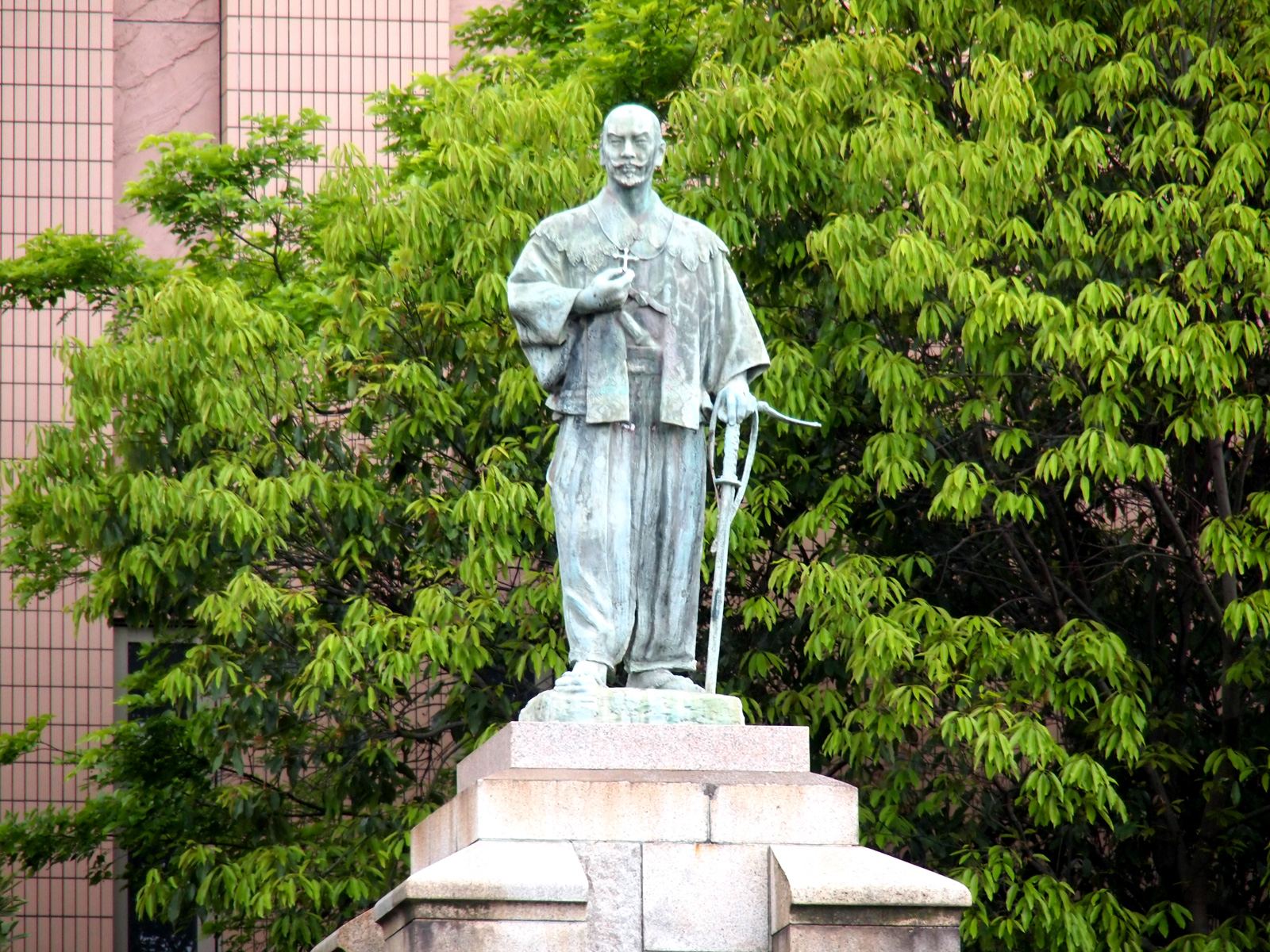
The audience of 1551
In September 1551 word came to Xavier in Yamaguchi that a Portuguese ship had arrived in Bungo, on the east coast of Kyushu. The young lord of Bungo, Ōtomo Yoshishige, invited him to Funai, his capital. He had become head of the house the year before, at twenty. Ōita City calls their meeting historic: from it came leave to preach Christianity. The city's own schoolbook remembers why the young lord was ready to listen. At fifteen he had seen a Chinese junk bring six or seven Portuguese into the harbour, and when a sailor urged his father to rob them, he refused: they had come trusting the port, and had done no wrong. Sōrin wrote to Xavier that he wished to talk with him about many things, and Xavier, who knew the mission needed a lord's protection, set out at once. Sōrin welcomed him gladly, listened to him speak of the faith and of the world beyond the sea, and gave leave to preach.
Xavier stayed only about two months. When he left, the lord sent a letter and an envoy to the King of Portugal, and from 1552 many Portuguese missionaries came to Funai.
Sources: the audience of 1551
The city's history of Sōrin, written for its "" programme; the Board of Education's 2026 booklet Ōtomo Sōrin and the Town of Funai, which retells what Sōrin himself told the missionaries; and Schurhammer's life of Xavier, which uses the Jesuit letters.
A city of firsts
In 1553 a church known as the Deus-dō was built in what is now Kentoku-machi 1-chōme. Two years later Luis de , a merchant of Lisbon who was also a physician, was shocked to find that in their poverty people abandoned or killed their babies. With Sōrin's support he built a home to take the children in. Wet nurses were hired, and two cows were kept so that the infants could have milk.
In 1557 Almeida and the priests built the Funai hospital, where, the city says, the first Western surgery in Japan was performed. Its work was carried by a volunteer brotherhood, the . It had a general ward and a ward for lepers, and Almeida, using his own fortune, took charge of the surgery himself and taught it at the bedside. The wooden hospital had sixteen rooms and twelve helpers, and its name spread so far that people came from Kyoto and Sakai to be treated. By 1562, the city notes from the records of the time, it had more than a hundred patients. Almeida, who had come as a merchant, joined the Jesuits in Japan.
The church itself, built with Sōrin's help by about 1553, had a chapel, a house for the missionaries, a cross, a garden and a graveyard. Mass was said every day. At Christmas a new cross was cut from a tree trunk, and at Easter the Japanese choir sang and once rice cooked with beef was shared. At Christmas 1560 the church staged plays of the fall of Adam and the hope of redemption, and of the judgement of Solomon, told in Japanese song. After Xavier, built a residence and hospital in Bungo; the faithful were mostly the poor and the sick, and they are said to have numbered five thousand. The same year the first Japanese church choir was formed at the Funai church, and in 1561 Japanese boys played the viol.
In 1581, with the Visitor Alessandro , a college, the , was opened at Funai, teaching languages, astronomy, philosophy and the classics of Europe and Japan. It lasted six years. The Board of Education calls it the first college of higher studies for missionaries in Japan, and adds theology, meteorology and music to its subjects.
Sōrin protected the mission but was himself a Zen believer; he shaved his head and took the name Sōrin. In 1578, at 48, he was baptised at last, and chose the name Francisco, it is said after . The Board of Education puts it plainly: he took the name of the Xavier he revered. In Europe he became the best known Japanese of his age, the "King of Bungo". The same year his army was defeated by the Shimazu at Mimikawa, and his power began to fade. In 1586 the Shimazu army invaded and the trading city of Funai was burned. Sōrin died in May 1587.
Under the city
Since 1996 the city has been excavating the Ōtomo sites. Venetian glass has been found, and many wares from China, Korea, Thailand, Vietnam and Myanmar. The Ōtomo residence, in Kentoku-machi 3-chōme, was square, about 200 metres a side, modelled on the shogun's palace in Kyoto. Part of it was designated a national historic site on 13 August 2001, and in 2005 the site was extended and renamed the Ōtomo Sites. The church, the city believes, stood on the westernmost street of the old town, with the hospital beside it. Today the long Yūho Park in front of the prefectural office carries monuments to the age: a statue of Almeida beginning an operation with a Japanese assistant, and a monument to the children's home and its milk. The Nanban BVNGO exchange hall beside the residence site tells the Ōtomo story.
