十Christian Japan
Place guide · Nagasaki · Church

Ōura Cathedral

World Heritage component

A church built for foreign merchants, with one Japanese word over its door. Why did a few farmers from Urakami walk through it in March 1865, and what changed when they did?

4 min read13 sources4 pinsVisitingTap any name, place or term to learn moreTimeline

A church built to be found. Ōura was a church for foreigners on paper, but its builders hoped that the descendants of the old Christians would see it and come.

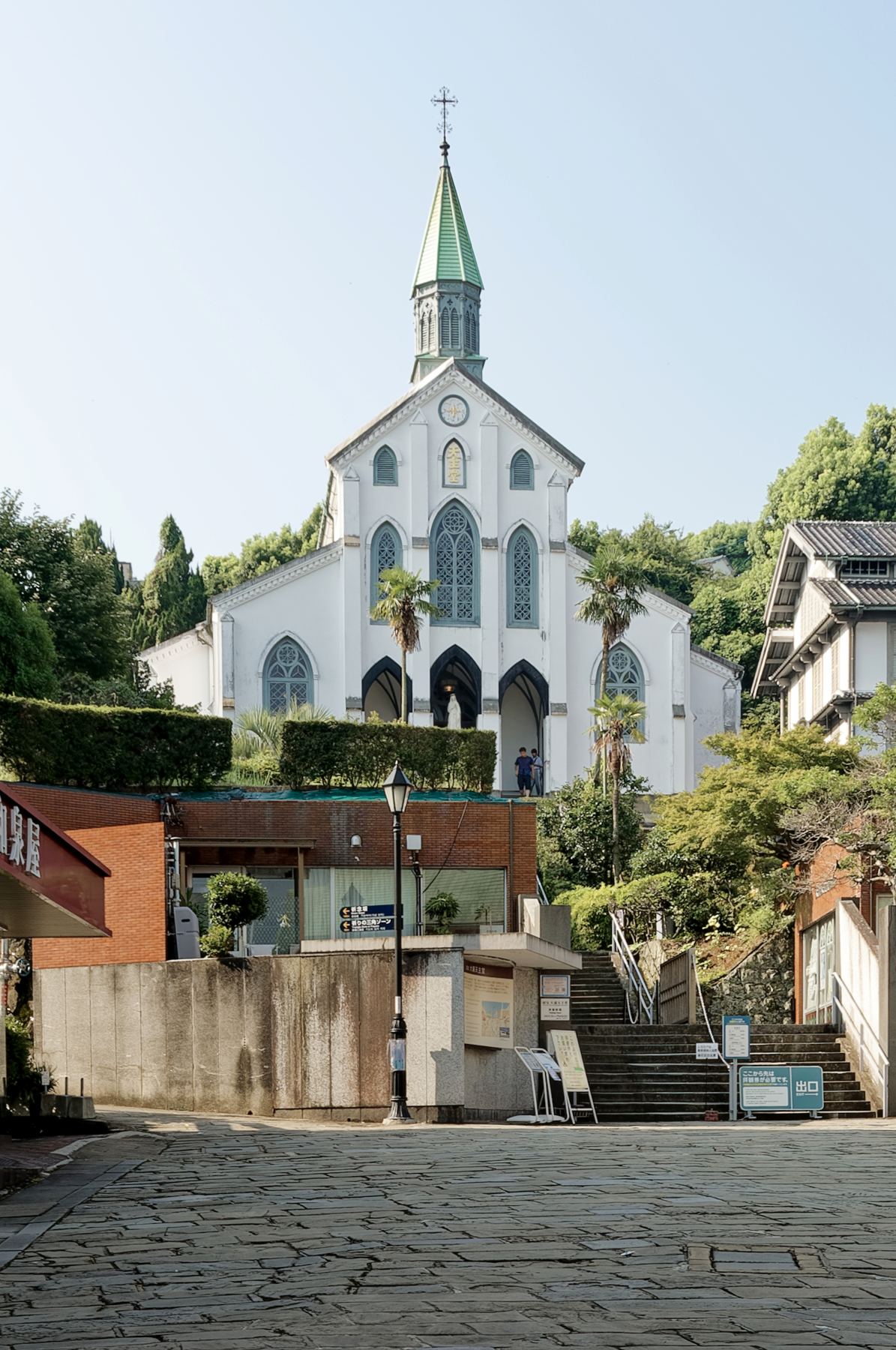
Ōura Cathedral on its hillside, white plaster front and spire
Ōura Cathedral on its hillside, white plaster front and spire.Oura Church in Nagasaki, 2024. Jakub Hałun, CC BY 4.0. Commons

In 60 seconds

The place in 8 steps. Each line is footnoted.

  1. 1863Furet and Petitjean of the Paris Foreign Missions Society reach Nagasaki.
  2. 1864The church is built on the hill at Ōura, facing Nishizaka.
  3. 19 Feb 1865It is dedicated to the Twenty-Six Martyrs of 1597.
  4. 17 Mar 1865Urakami villagers tell Petitjean they share his faith.
  5. 1875The Latin seminary opens beside the church to train Japanese priests.
  6. 1879The church is enlarged into the building that stands today.
  7. 1933It becomes a National Treasure; Church Trust calls it Japan's oldest standing church.
  8. 2018It is listed as a World Heritage component.

A knock at the door

Shortly after noon on Friday 17 March 1865, twelve to fifteen men, women and children stood at the shut door of the new church on the hill. Father opened it, walked toward the altar and knelt. Three women knelt beside him, and one of them said very quietly: "The heart of all of us here is the same as yours." Then she asked where the image of Holy Mary was.

They were farmers from , a valley north of the city, whose families had kept their faith in secret for more than two hundred years. The school guide for Nagasaki calls what happened next the meeting of hidden Christians and a priest "for the first time in about 200 years". Today the place is a World Heritage component because of that meeting: it shows how the age of hiding came to an end.

1863 to 1865

A church built to be found

The treaties of the 1850s opened Nagasaki to foreign residents, and with them came priests of the Paris Foreign Missions Society. reached Nagasaki in 1863 and Bernard Petitjean followed in August. The prefecture's heritage site names Furet as designer and Koyama Hidenoshin as builder.

The church went up in 1864 on the hill at Ōura, in the foreign settlement. It was turned to face , where twenty-six Christians had been crucified in 1597, and it was dedicated to them on 19 February 1865. Captains of French, British, Dutch and Russian ships came with their men and fired salutes, but the Nagasaki magistrate sent only a deputy. Church Trust dates the completion to 29 December 1864; a Nagasaki City feature dates it to November 1864.

On paper it was a church for foreigners. But on the front the priests wrote the word in Chinese characters, so that Japanese passers-by could read it, and the prefecture says the priests hoped that believers who had kept their faith in secret were still out there. The sign was an invitation. It took about a month to be answered.

On the mapFacing Nishizaka
Ōura Cathedral, Nishizaka Park. Full atlas and pin sources
1865

Santa Maria

The villagers tested the priest as carefully as he tested them, asking about the feasts they kept and the "time of sorrow". Over the next days more came, and they gave the priests their baptismal names: "My husband is Paolo, my son here is Petoro, and I am Marina."

The statue they asked for still stands at the side altar, to the right as you enter. The school guide says this is where they spoke to Petitjean, and the prefecture's panel says the Mary at the side altar is the one from that time and that the space inside has been kept.

Sources: santa maria

Petitjean described the day in letters of 18 and 22 March 1865, quoted day by day by the society's historian Francisque Marnas in 1897. The World Heritage panel and the school guide give the Japanese official account. Translations of the French and Japanese here are ours.

1865 to 1873

The news spreads

The news of the Discovery went out to hidden communities across the region. Their leaders came to the church in secret, and the prefecture says this contact is what ended the age of hiding: some returned to the Catholic Church, some kept their own form of faith, and some became Buddhist or Shinto. The ban was still law. In 1867 the Urakami villagers who had declared themselves were arrested, in the last great , the fourth Urakami crackdown, and from 1868 they were sent into exile; the boards banning Christianity came down only in 1873.

On the mapFrom Urakami to Ōura
Ōura Cathedral, Urakami Cathedral. Full atlas and pin sources
1875 to 1933

A seminary and a treasure

The church became the centre of the new Catholic Church in Japan. In 1875 Father built a Latin seminary beside it to train Japanese priests, and its graduates went out to the old hidden communities. The church itself was enlarged in 1875 and 1879 into the present building, brick under white plaster, so that the brick is hard to see. Bishop Petitjean blessed the rebuilt church on 22 May 1879. He died in 1884 and is buried in the church.

Church Trust, which looks after the building, calls it the oldest church building standing in Japan: the Yokohama church of 1862 was older but was moved and rebuilt in 1906. Ōura was named a National Treasure in 1933 and designated again in 1953. The old seminary and the archbishop's house next door are now the Kirishitan Museum.

On the mapThe hill today
Ōura Cathedral, Former Latin Seminary. Full atlas and pin sources
Today

A working church

Ōura is still a church, and a museum of its own story. It is open every day except for church events, and it is the only World Heritage church in the region that needs no advance notice to visit. Go early. Stand at the side altar, and look back toward the door the villagers came through.

Timeline

The dated story

Every dated event on this page, with its sources. Filter by section.

  1. 12 Jan 1862French missionaries dedicate their church in Yokohama
  2. 8 Jun 1862Pius IX canonises the Twenty-Six Martyrs
  3. 1863Furet and Petitjean reach Nagasaki
  4. 1864Church built at Ōura, facing Nishizaka
  5. 19 Feb 1865Dedication to the Twenty-Six Martyrs
  6. 17 Mar 1865The Discovery: Urakami villagers speak to Petitjean
  7. 2 Jun 1867Our Lady of Japan set up at the gate for the Discovery ceremony
  8. 1867Arrests in Urakami (the fourth kuzure)
  9. 1873Notice boards banning Christianity removed
  10. 1875Latin seminary built by de Rotz
  11. 22 May 1879Enlarged church blessed by Bishop Petitjean
  12. 17 Dec 1881Bishop Petitjean blesses the garden cross
  13. 1884Petitjean dies; buried in the church
  14. 15 Jun 1891Diocese of Nagasaki created, Ōura its cathedral
  15. 1915Archbishop's house rebuilt (now museum)
  16. 23 Jan 1933National Treasure
  17. 30 Jun 1952Restoration after the atomic bomb damage completed
  18. 31 Mar 1953Re-designated National Treasure
  19. 1 Jan 1962Cathedral moves from Ōura to Urakami
  20. 2018World Heritage listing
Atlas

Where it happened

Each pin is a place named on this page. Coordinates come from official prefecture maps, OpenStreetMap or Wikidata, as listed. Rows marked "not yet pinned" have no verified pin.

This placeRelated site
PlaceWhy it matters hereCoordinatesCoordinate source
Ōura CathedralThe church of the Discovery32.734189, 129.8701625OpenStreetMap way/243003159
Former Latin Seminary, ŌuraDe Rotz's seminary of 1875, now museum32.7342063, 129.8699169OpenStreetMap way/632548267
Nishizaka ParkMartyrdom site of 1597 the church faces32.7543629, 129.8716442OpenStreetMap way/875993473
Urakami CathedralHome valley of the villagers of 186532.7761633, 129.8683892OpenStreetMap way/280652259
Name cards

People, places and events

Who and what this page touches. Dashed cards are pages still to come.

Visiting

If you go

Practical details change. Check with the operators before you travel. Churches are places of worship: please follow the visitor manners asked of you.

Read next

Where to go from here

Glossary

Words on this page

tenshudō 天主堂
"Hall of the Lord of Heaven": the word written over the door in Chinese characters.
the Discovery 信徒発見
"Discovery of the believers": the meeting of 17 March 1865.
kuzure 崩れ
"Collapse": the exposure and mass arrest of a hidden community.
Sources

Footnotes

Translations from Japanese sources are ours.

  1. "Nagasaki and Amakusa Hidden Christian Sites" Preservation and Utilisation Committee, 学校教育用補助教材(長崎市用)[School supplement, Nagasaki City edition] (March 2020), pp. 9 to 14, source link
  2. Nagasaki Prefecture World Heritage Division, component panel "12. Oura Cathedral" (kirishitan.jp), source link
  3. Church Trust, "歴史 / History" (Ōura), source link
  4. Nagasaki Prefecture, おらしょ こころ旅, "大浦天主堂" (component page, glossary entries for Petitjean and Furet, access and opening hours), source link
  5. Francisque Marnas, La Religion de Jésus ressuscitée au Japon dans la seconde moitié du XIXe siècle, vol. 1 (Paris and Lyon, 1897), Book 2, ch. 1, pp. 487 to 500, quoting Petitjean's letters of 18 and 22 March 1865
  6. UNESCO World Heritage Centre, "Hidden Christian Sites in the Nagasaki Region" (no. 1495, 2018), source link
  7. Kotobank, "杉本ゆり" (Nihon jinmei daijiten), source link
  8. Nagasaki City, Nagazine, "大浦天主堂の創建と信徒発見" (church/9), source link
  9. Japan Tourism Agency, "The Last Major Arrest: The 'Fourth Urakami Crackdown'" (PDF), source link
  10. Japan Tourism Agency, "高札撤去:信仰が自由な時代へ" (PDF), source link
  11. Nagasaki Prefecture tourism (ながさき旅ネット), "教会見学時マナーのご案内," source link
  12. Nagasaki Church Trust, "大浦天主堂の歩み" (chronology), source link (checked 20 Oct 2026)
  13. Nagasaki Church Trust, "拝観順路" (viewing points: Petitjean statue, great cross, Our Lady of Japan, stained glass, Discovery Mary), source link (checked 19 Oct 2026)
The wider story

For the wider story around this place, see Nagasaki: the Christian city.

Images

Image credits