"Anmen riyusu"
In 1805 the magistrate's men came to Sakitsu. In what became known as the Amakusa crackdown, the Amakusa , seven out of ten villagers were found to be hidden Christians. They were told to hand over their sacred objects at the village shrine, Sakitsu Suwa Shrine.
The record of the questioning survives. One of the leaders of the village's faith said that whenever he went to pray, whichever way he went, he said "anmen riyusu". The prefecture explains the words as a prayer used by the hidden Christians, probably from "Amen, Deus" or "Amen, Jesu".
The villagers were not punished. The authorities treated them as people who had merely "misunderstood", kokoroechigai.
Sources: "anmen riyusu"
The official World Heritage page sets out the village's history. The prefecture's おらしょ site adds the shrine and church records, including the 1805 questioning.
A shrine, a god of fishermen, a shell
Sakitsu was already a village in the age of the warring states. Christianity reached it after Brother Luis de of the Jesuits began the mission in 1569, and many devotional objects came with it. Then came the ban. Every year at the Yoshida headman's office the villagers had to tread on images of Christ and Mary, the , and the temple registers recorded the faith and temple of every household.
To look like everyone else, the Christians became parishioners of Sakitsu Suwa Shrine and of the temple. The shrine had been founded in 1647 to pray for good catches and safety at sea, and a torii gate dated 1685 still stands in its grounds. In secret they kept the , the small groups that went back to the sixteenth century, led by a who baptised and led funerals and the feasts of the church calendar.
Their faith grew out of their work. They worshipped and Ebisu, the gods of good catches, as Deus, the one God, and saw the Virgin Mary in the pattern inside an abalone shell. They also made medals from mother-of-pearl. The mizukata's descendants still keep medals and other objects of the sea in their home.
Two churches
After missionaries came back to Amakusa in the later nineteenth century, Sakitsu's Christians were baptised again and returned to the Catholic Church. In 1888 the first church was built, by local carpenters, on land beside the shrine where they had once prayed in secret. The land had belonged to a former mizukata. The prefecture sees it as the symbol of the end of hiding in Sakitsu. A convent built in the 1950s now stands on the site; the stone walls remain, but visitors may not go in.
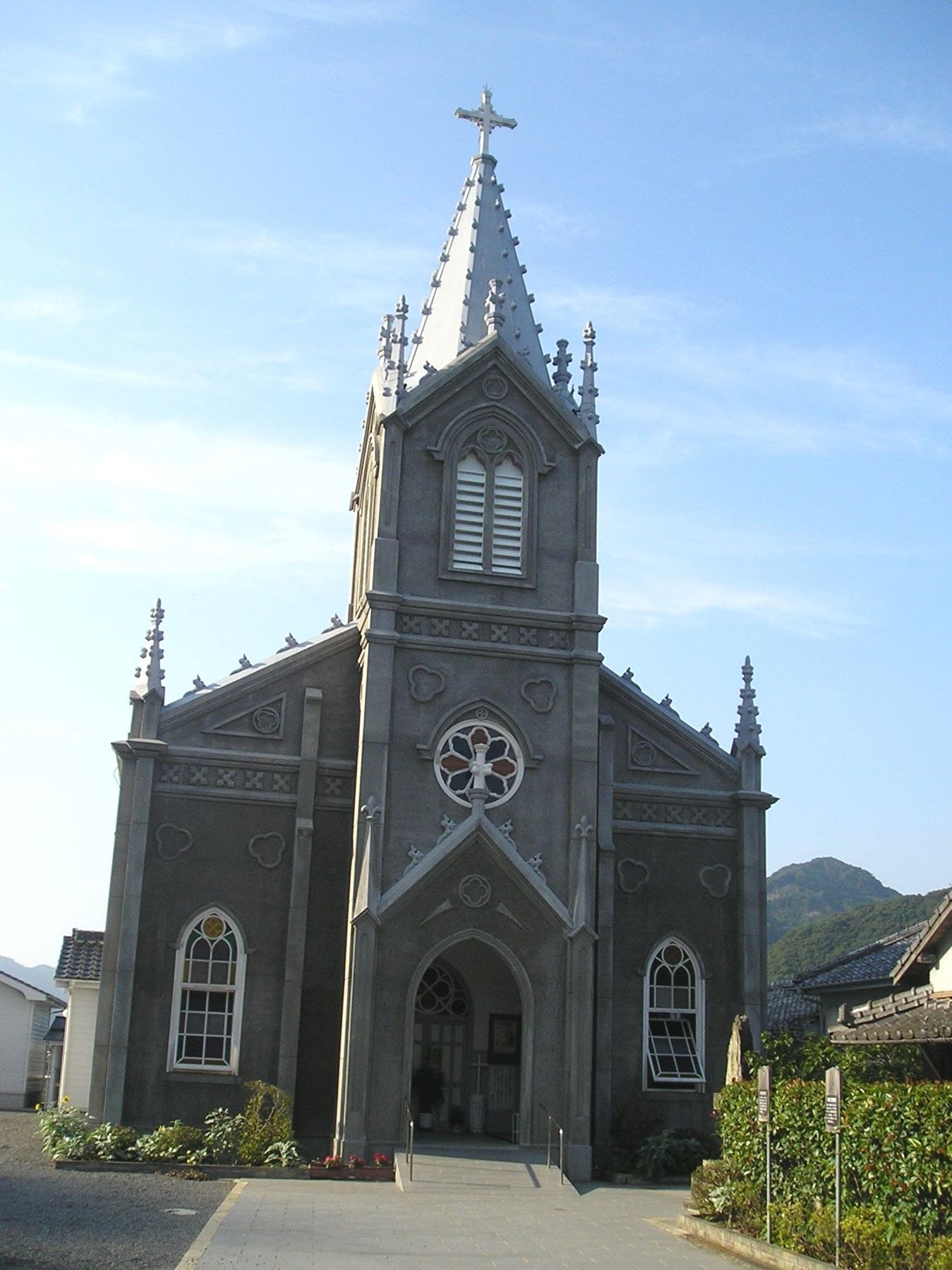
The wooden church grew old. Father Augustin of the Paris Foreign Missions, who had come to Japan in 1889 and was parish priest of Sakitsu from 1927 for seventeen years, wanted the new church on the ground where the treading had been held, the site of the Yoshida headman's office. It was designed and built by the master builder and finished in 1934. Inside, the floor has been laid with tatami from the start.
The church and the shrine
The church is still a place of worship. The road up to it is shared by the Corpus Christi procession and the festival of the Suwa shrine. In 2011 the village and its neighbour Imatomi were selected together as an Important Cultural Landscape.
