十Christian Japan
Place guide · Nagasaki · Church site and museum

Santo Domingo Church Site, Nagasaki

Under a primary school in the middle of Nagasaki lies the floor of a church that stood for only five years. How did a Dominican church come here by sea, and how was it found again?

4 min read7 sources4 pinsVisitingTap any name, place or term to learn moreTimeline

A church that was carried across the sea in pieces, pulled down in 1614, and buried under three hundred years of magistrates' houses. Rebuilding a school in the late twentieth century brought it back into the light.

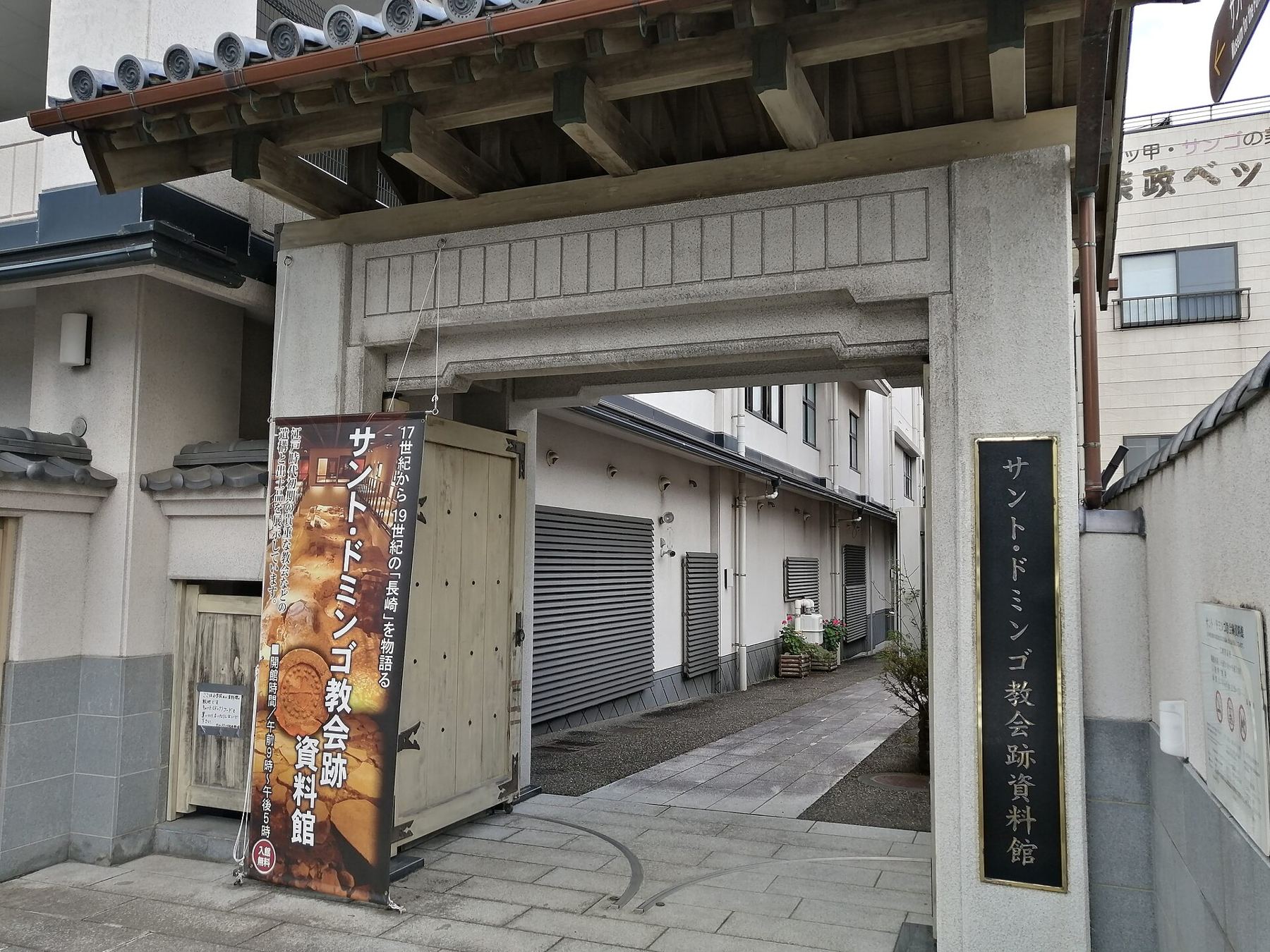
The entrance of the Santo Domingo Church Site Museum
The entrance of the Santo Domingo Church Site Museum.Santo Domingo church museum entrance, 1 December 2021. DoctorDoughnut, CC BY-SA 4.0. Commons

In 60 seconds

The place in 7 steps. Each line is footnoted.

  1. 1602 to 1606The Dominicans build a church in Satsuma and move it once.
  2. 1609They take it apart again and rebuild it in Nagasaki, on land given by Murayama Tōan.
  3. 1614The church is destroyed under the ban on Christianity.
  4. 1663The great Kanbun fire burns the site, now the Suetsugu magistrates' mansion.
  5. 1676The Suetsugu family falls; the Takagi family follows as magistrates.
  6. Late 1990s or 2000The church floor is found when the school is rebuilt.
  7. TodayA free museum under Sakuramachi primary school.

Timbers by sea

In 1609 a ship came into Nagasaki loaded with the pieces of a church. The Dominicans, who had come to Japan from Manila, had been preaching in . When their leader, Father , was ordered out, he had the church of Our Lady of the Rosary dismantled and carried to Nagasaki. The city's own history magazine says the timbers came from the church at Kyōdomari, in present-day Satsumasendai, and were shipped across. The Japan Tourism Agency counts an earlier move too: a first church on Shimokoshiki island in 1602, moved to Sendai in 1606, and moved again to Nagasaki in 1609.

The land was a gift from , the magistrate of Nagasaki, himself a Christian baptised Antonio. The church was built of wood on stone foundations, and was one of the last churches built in the city. It was named for St Dominic, the founder of the order.

The Dominican historian Bertrand Wilberforce tells the story from the friars' side. The first church of the order in Japan, dedicated to Our Lady of the Holy Rosary, had been opened at Kyōdomari in Satsuma in 1606, with its first Mass on the feast of the Visitation. When the lord of Satsuma ordered the friars out in 1609, Morales went to Nagasaki, "the capital of Christianity in Japan", and took with him some lepers for whom he had founded a hospital, because he would not leave them to the mercy of strangers. There he founded a church under the name of Our Lady of the Rosary and St Dominic. Profillet dates the move to the first days of May 1609. In its inner garden, and in the vegetable garden, the friars set up crosses.

Morales did not leave Japan when the church fell. He was later taken in the Nagasaki house of his host, Andrew Tokuan, who led the men of the city's confraternity of the . Profillet gives the day, 15 March 1619: a young man under torture had revealed where the priest was living. The officer sent to take him, the renegade Yasuemon, greeted him with respect and asked his pardon. Morales answered: "You are welcome, Yasuemon-dono. Far from bearing you any bitterness, I am grateful to you, and I could know no greater happiness than to be a prisoner for Jesus Christ." From his first prison, on an island of the Hirado domain, a room two mats long, he wrote to the Spaniards of Nagasaki: "We have only the flowers and the roses; the Son of God kept the real trials for Himself." Note: our translations.

After more than two years in the prison of Ōmura he was brought back to Nagasaki and burned alive on 10 September 1622, the day of the Great Martyrdom. On the hill of Nishizaka he blessed Tokuan's wife Mary, who knelt at his feet, before they died. Pius IX beatified him.

Sources: timbers by sea

The church's history comes from the prefecture's おらしょ site, the Japan Tourism Agency's commentary and Nagasaki City's magazine Nagazine. They agree on 1609 and 1614 but tell the earlier journey differently, so it is marked Disputed below. The finds were made in the city's excavation.

On the mapChurches of old Nagasaki
Santo Domingo Church Site Museum, Nagasaki Museum of History and Culture, Tip of the Nagasaki cape. Full atlas and pin sources
1614 to 1868

The magistrates' houses

Five years later the ban on Christianity of 1612 to 1614 ordered all churches destroyed, and Santo Domingo was pulled down. Carla Tronu, in her study of Nagasaki's Christian spaces, dates the dismantling to 1615 and the residence of the magistrate, the , on top of it to 1619. On its ground the new magistrate, , built his mansion. Suetsugu, the city magazine notes, was the man who had brought a lawsuit against Murayama Tōan; Tōan was denounced as a Christian and executed in Edo in 1619, and Suetsugu took his post.

The Suetsugu held the office by inheritance until 1676, when they were caught in smuggling and fell. In 1663 the Kanbun fire burned almost the whole of Nagasaki, this house with it. The family then took over the duties, and from 1739 were magistrates in their own right until the end of the Edo period.

2000 to today

Found under a school

When the old school here was to be rebuilt, the remains of the church were found. the Japan Tourism Agency says the late 1990s; the prefecture says the survey took about a year from 2000. The survey found more than 120,000 objects and many building remains. The prefecture says the real surprise was that church remains had survived at all, since the magistrates' houses had been built on top of them.

The school was redesigned to keep them, and the museum lies beneath it. From a raised walkway you see the church's basement, a stretch of Iberian-style stone paving with drains, and a well of the Takagi period. Fifteen wells were found on the site, most of them from the Takagi house.

Timeline

The dated story

Every dated event on this page, with its sources. Filter by section.

  1. 1602First Dominican church on Shimokoshiki (JTA; Disputed)
  2. 1606Moved to Sendai in Satsuma (JTA)
  3. 1609Church rebuilt in Nagasaki by Fr Francisco de Morales
  4. 1606First Dominican church in Japan opened at Kyōdomari
  5. 1614 or 1615Destroyed under the ban
  6. 15 Mar 1619Morales arrested in Tokuan's house
  7. 10 Sep 1622Morales burned alive at Nishizaka, the Great Martyrdom
  8. Under Pius IXMorales beatified
  9. 1619Murayama Tōan executed in Edo
  10. 1663Kanbun fire
  11. 1676Suetsugu family falls
  12. 1739Takagi family appointed magistrates
  13. Late 1990sRemains found during school rebuilding (JTA; Disputed)
  14. 2000Year-long excavation begins (prefecture; Disputed)
Atlas

Where it happened

Each pin is a place named on this page. Coordinates come from official prefecture maps, OpenStreetMap or Wikidata, as listed. Rows marked "not yet pinned" have no verified pin.

This placeRelated site
PlaceWhy it matters hereCoordinatesCoordinate source
Santo Domingo Church Site MuseumUnder Sakuramachi primary school32.7511173, 129.8794492OpenStreetMap way/90964486, school building
Nagasaki Museum of History and CultureUp the side road; site of the Tateyama magistrate's office32.7529942, 129.8794534OpenStreetMap way/1458263737
Sakura-machiThe district around the site32.749988, 129.8781524OpenStreetMap node/8444589615, district level
Tip of the Nagasaki capeSite of the Jesuits' Misaki church32.744627, 129.873818OpenStreetMap node/8444589562, district level
Kyōdomari, SatsumasendaiWhere the timbers came fromlocation not pinnednot yet pinned
Name cards

People, places and events

Who and what this page touches. Dashed cards are pages still to come.

Visiting

If you go

Practical details change. Check with the operators before you travel. Churches are places of worship: please follow the visitor manners asked of you.

Read next

Where to go from here

Glossary

Words on this page

hanajūjimon 花十字紋瓦
A roof tile stamped with a flower-shaped cross.
daikan 代官
A local magistrate; in Nagasaki, the official in charge of the town.
rosary ロザリオ
A string of beads used in prayer, also called contas.
Sources

Footnotes

Translations from Japanese sources are ours.

  1. Nagasaki Prefecture, おらしょ こころ旅, "サント・ドミンゴ教会跡" (asset page, glossary, access, address), source link
  2. Japan Tourism Agency, Multilingual Commentary Database, "Santo Domingo Church Museum" (R2-00457), source link
  3. Nagasaki City, Nagazine, "発見!長崎の遺跡" part 2, "勝山町遺跡 江戸初期、ここには教会があった!," source link (checked 19 Oct 2026)
  4. Nagasaki Prefecture, おらしょ こころ旅, column "ここに教会があった証," source link
  5. Bertrand Wilberforce OP, *Dominican Missions and Martyrs in Japan* (1897), pp. 21 to 24 and the list of beatified martyrs, source link
  6. Carla Tronu Montane, *Sacred Space and Ritual in Early Modern Japan: The Christian Community of Nagasaki (1569 to 1643)*, PhD thesis, SOAS, University of London, 2012, source link
  7. Louis Charles Profillet, *Le martyrologe de l'Église du Japon, 1549 to 1649*, vol. 1 (Paris), "Les bienheureux", entry "Moralez (François de)", pp. 258 to 265, source link
The wider story

For the wider story around this place, see Nagasaki: the Christian city.

Images

Image credits