十Christian Japan
Place

The Takaya Headman's Estate, Urakami

The house where Urakami's Christians trod on the fumi-e and were sentenced to exile, bought by their children in 1880 for their church.

1,430 words20 sourcesTap any name, place or term to learn moreTimeline
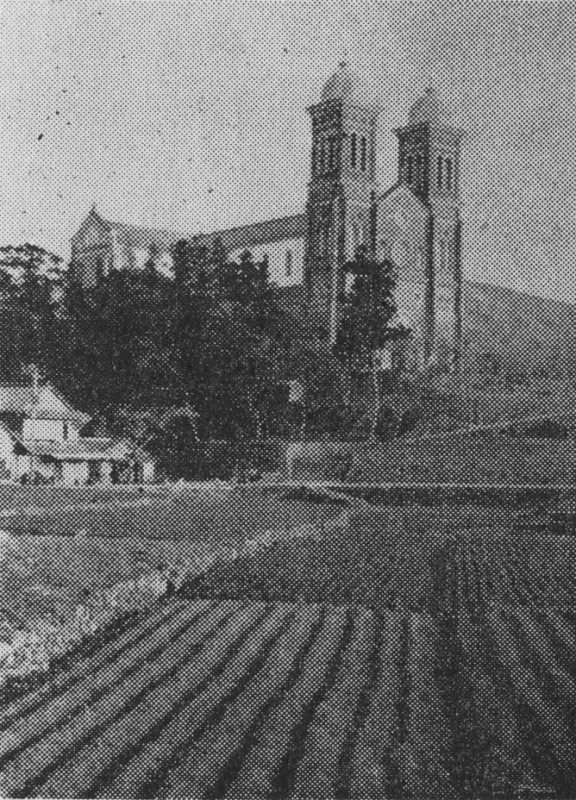
Original Urakami Cathedral before the atomic bombing
Original Urakami Cathedral before the atomic bombing Unknown author, via Wikimedia Commons (public domain)

The story

The opening line of each part of the story.

  1. 1From 1605 the Takaya family were the headmen of Urakami, and their house stood on the rise where Urakami Cathedral stands today.
  2. 2Every New Year from 1641 to 1857, the village's Hidden Christians were made to tread on the fumi-e there.
  3. 3In 1790 the headman Takaya Eizaemon denounced nineteen villagers as Christians, beginning the first Urakami crackdown.
  4. 4In January 1870 the families of Urakami were sorted under flags in its garden and sent into exile.
  5. 5The headman's family fell, and in 1880 the returned Catholics bought the estate and made the house their church.
  6. 6A cathedral rose on the headman's ground and was dedicated in 1915; the old house became a catechism hall.
  7. 7The bomb of 1945 burned the house and the persimmon tree at its gate, and the tree's root became a cross carried round the parish.

Mass in the headman's house

On August 15, 1880, the feast of the Assumption, about 1,500 Catholics crowded into the old house of their village headman for Mass. The partitions had been taken out, leaving only the pillars under the roof, and a light earth wall closed in the space.

The house stood on a rise called Takaya, in the middle of Urakami, the farming valley just north of Nagasaki whose families had kept their Christian faith in secret through the centuries of the ban. For more than two hundred years the headmen had called them here every New Year to tread on images of Christ and Mary. Ten years earlier, in the garden, they had been sentenced to exile. Now the house was theirs.

The headmen of Takaya

The house went back to 1605, when the part of Urakami that is now the Catholic parish was taken under the shogun's direct rule as the village of Urakami Yamazato. Its first headman was Kikuchi Masashige, a masterless samurai from Higo, in Kyūshū. His house stood on the Takaya rise, and he took the name Takaya. Until the end of the shogunate, the Christians of Urakami lived under the Takaya headmen. Yamazato had five hamlets, and in four of them every farming family was Christian.

The house had the best ground in the village, high and dry in the middle of the valley. The headmen took part in every arrest and examination of Christians, and every New Year they summoned the villagers to the house for the treading.

New Year at Takaya

The treading began at Urakami in 1641. The fumi-e, a holy image laid on the ground to be stepped on, went round in the New Year month of the old calendar: the town of Nagasaki first, then Nagasaki village, then Urakami Yamazato and Urakami Fuchi. Young and old, men and women, the sick and babies in arms, everyone stepped on it. Anyone who would not was known at once for a Christian and arrested.

For the Hidden Christians of Urakami it was the saddest and most painful thing of all. They asked pardon for it with the Konchirisan, the prayer of perfect contrition handed down for a people with no priest to hear their confessions.

The headman who informed, 1790

Not every headman was content to watch. In 1790 Takaya Eizaemon and his kinsmen planned eighty-eight stone Buddhas for the temple of Enpukuji, and many villagers refused to give money. Eizaemon secretly denounced nineteen of them as Christians, and the arrests were led by Tsukada Gunbei, a clerk of the Nagasaki intendant whom he had bribed. The evidence was not there. When the plot came out, Eizaemon was confined in September 1791 and had to hand the headmanship to his son, Tōkurō.

It was the first of the Urakami crackdowns, and the affair dragged on until 1795. Two more crackdowns followed, in 1839 and in 1856.

The refusal and the sentence, 1867 to 1870

Nagasaki's last treading came at the New Year of 1857, after the Dutch factor Donker Curtius urged the shogunate to stop it. Ten years later, in 1867, two years after Urakami's Christians had found the French missionaries at Ōura, they stopped pretending to be Buddhists. Ten representatives of the four hamlets went to the headman to say they were breaking with the family temple, and more than 400 households followed with written refusals of the temple registration. The magistrate's raid of July 15, 1867, began the fourth crackdown.

On January 6, 1870, the day after the heads of household had been shipped out of Nagasaki, the families left behind came to the headman's house in groups. Flags marked East, West, South and North stood in the garden, and officials called each name and sent each person to stand under a flag. Marnas adds that they were told to board the ships or be shot where they stood.

Kataoka Sada set out that snowy morning with one daughter on her back and two by the hand. She remembered going to "the paddy below the Yamazato headman's house" and then on to the government office, praying the rosary aloud all the way. In all, 3,394 people were sent away, and Urakami was left empty.

The house for sale

The exiles came home in 1873 to wrecked and empty houses. Their secret chapels had been destroyed, and for Mass they walked to Ōura Cathedral, about 2 ri (8 km) away. In 1879 Aikawa Chūemon of Doi, back from the "journey", as the exiles called it, arranged with Father Poirier to make his elder brother Tomohachi's detached room by the river into a chapel. Dedicated to St. John the Baptist, it held about 200 people.

The headman's family, meanwhile, had fallen. Kanjūrō, the headman who had gathered the villagers for exile, died soon afterward. His eldest son, sent to the coal mine on Takashima to mend his ways, was killed there in a gas explosion. The new government had ended hereditary office, and the running of the village passed to an elected man. The widow was left with a sickly twelve-year-old son and no stipend. She cut and sold the trees that had surrounded the house, and at last put the whole estate up for auction and left the village.

The Catholics of Urakami worked to get it, and on June 4, 1880, the feast of the Sacred Heart, they signed the contract. The price was only 1,600 yen, at a time when a 60 kg bale of rice cost 2 yen 64 sen. On July 7, the feast of the 205 Blessed Martyrs of Japan, they began work on the house, and on August 15 they filled it for Mass. Marnas called it the old court of Urakami "changed into a sanctuary."

The headman's house as a church

The next year, 1881, the parish raised a wooden cross on a hill at Tsuji, now Jūjikayama, in reparation for the treading and in thanks that the persecution was over.

The headman's house served as the parish church for thirty-five years. It could hold about 1,400 people, Marnas reported, and still on Sundays the crowd could not all get in. The roof leaked, the timbers were rotting, and the parish grew to more than 5,000.

In September 1888 Father Fraineau, the new parish priest, began to plan a great church on the headman's ground, where for 250 years the cross had been trodden underfoot, as reparation for that sacrilege. Building began in 1895. When stone and brick were landed at Doi, the parishioners carried them "to the building site on the Takaya hill."

In 1902 the old house was moved to the east side, behind the rising church, and went on serving as the chapel. It was replaced when Urakami Cathedral was dedicated in March 1915, at the fiftieth anniversary of the day Urakami's Christians made themselves known at Ōura. The old house then became the catechism hall.

In a book that Father Urakawa quoted in 1928, the historian Anesaki Masaharu described the site: the former headman's estate, where in the persecution people had been summoned and scolded, now carried "the greatest cathedral in the East."

The persimmon tree

At the front of the finished cathedral, on the right, stood a persimmon tree, with a large natural stone beside it. The spot had been the entrance of the headman's house. Parish memory, set down in the parish's own history, held that the ancestors had been tied to that tree and tormented when they were examined for their religion. The stone was the headman's water basin, which, they said, had watched it all in silence. Photographs survive of the old house with the tree at its right edge, and of Father Fraineau and his parishioners beside it.

An older witness points the same way. In 1897 Marnas wrote that many Christians could testify they had been tortured on the Takaya headmen's orders, and that several remembered being tied to a tree that still grew in the middle of the main courtyard.

1945 and 1946

The atomic bomb of August 9, 1945, wrecked the cathedral. The persimmon tree burned, and so did the old headman's house.

A year later, in August 1946, the young men of the parish set out to restore the weekly round of Communion visits, district by district. They dug the root of the persimmon tree out of the ashes and made it into a cross, the Cross of the Communion Round, which went from district to district each week to call everyone to Communion. The parish says it is still carried every Sunday, handed on from district to district as the baton of the liturgy rota.

Who's who

  • Kikuchi Masashige (Takaya): first headman of Urakami Yamazato, appointed in 1605
  • Takaya Eizaemon: headman who denounced nineteen villagers in 1790
  • Tōkurō: Eizaemon's son, who took over the headmanship in 1791
  • Tsukada Gunbei: clerk of the Nagasaki intendant, bribed to lead the 1790 arrests
  • Kanjūrō: headman when the villagers were sent into exile in 1870
  • Kataoka Sada: exile who remembered gathering below the headman's house
  • Aikawa Chūemon: returned exile who arranged the chapel at Doi in 1879
  • Father Poirier: first parish priest of Urakami
  • Father Fraineau: parish priest from 1888, who planned the cathedral on the estate
  • Anesaki Masaharu: historian who described the site in the 1920s
Timeline

The dated story

Every dated row in this story, with its source.

  1. 1605Kikuchi Masashige appointed headman of Urakami Yamazato; his house stands on the Takaya rise
  2. 1641the fumi-e treading begins at Urakami
  3. 1790Takaya Eizaemon denounces nineteen villagers
  4. September 1791Eizaemon confined; his son Tōkurō becomes headman
  5. 1857the last treading at Nagasaki
  6. 1867ten representatives tell the headman the villages are leaving the temple
  7. January 6, 1870the families sorted under flags in the headman's garden
  8. 1873the exiles return
  9. 1879chapel opened at Doi
  10. June 4, 1880the estate bought for 1,600 yen
  11. August 15, 1880Mass in the converted house
  12. 1881the cross raised at Tsuji (Jūjikayama)
  13. 1895building of the cathedral begins on the estate
  14. 1902the old house moved behind the church
  15. March 1915cathedral dedicated according to the parish history; Urakawa gives March 17, 1914; the old house becomes a catechism hall
  16. August 9, 1945the house and the persimmon tree burn
  17. August 1946the root of the tree made into a cross
Atlas

Every place in this story

Every place in this story. Each pin is marked as an exact site, town level or approximate. Places without coordinates are listed without a pin.

Exact siteApproximate or town level
PlaceWhy it matters hereCoordinatesCoordinate source
Urakami CathedralUrakami Cathedral (Takaya estate): 32.7761633, 129.8683892, exact site (OSM way/280652259). 32.77616, 129.86839Exact site 32.7761633, 129.8683892, exact site (OSM way/280652259).
Jūjiyama Related, not pinned here.32.78533, 129.87618Exact site Same point as Urakami: 32.78533, 129.87618 (exact site)
Doi chapel sitenot pinned; location only described.
Full record

Key facts

FactValueStatusSource
First headmanKikuchi Masashige, 1605Solid; family origin Disputed
Treading at Urakami1641 to 1857Solid
First crackdown1790 to 1795Solid
Sentence of exile in the gardenJanuary 6, 1870Solid
Estate boughtJune 4, 1880, 1,600 yenSolid
Mass in the houseAugust 15, 1880, about 1,500 presentSolid
House moved1902Solid
Cathedral dedicatedMarch 18, 1915 (parish chronology; Urakawa 1928 gives March 17, 1914)Solid
House and tree burnedAugust 9, 1945Solid
Root cross madeAugust 1946Solid
Persimmon tree at the former entranceused to bind Christians during examinationsSolid
Glossary

Words in this story

fumi-e
a holy image of Christ or Mary laid on the ground for people to step on, to prove they were not Christians
Konchirisan
the prayer of perfect contrition, said in place of confession
kuzure
a crackdown on Christians, literally a "collapse"
ri
an old Japanese unit of distance, about 4 km
Sources

Notes and sources

20 notes
  1. 1 Marnas, vol. 2, p. 431 (first Mass on August 15, 1880, before 1,500 people, the partitions removed and the space closed with a light earth wall).
  2. 2 Urakami Cathedral parish history, 「浦上小教区の成りたち」 (Takaya is the site of the present cathedral), https://uracathe.sakura.ne.jp/naritati.htm and 「総流配より帰郷後の窮乏 / 仮聖堂の建立 / 十字架山参詣地設立」, section 6.2, https://uracathe.sakura.ne.jp/ruhaigo.htm (read October 26, 2026).
  3. 3 Urakami Cathedral parish history, 「浦上小教区の成りたち」, https://uracathe.sakura.ne.jp/naritati.htm (Kikuchi Masashige 菊地蒲三郎正重, appointed Keichō 10, renamed 高谷小右衛門. The hamlets were Magome, Sato, Nakano, Motohara and Ieno, all Christian except Magome). Disputed: Marnas, vol. 2, p. 429, calls the family Takadani and says it was said to descend from the old daimyo of Higo and to have governed Urakami for five or six hundred years. The parish history has the first headman appointed in 1605.
  4. 4 Urakawa 1928, p. 772 (高谷の來歷, 「村の中央高燥絶勝の地に邸宅を構へ」), NDL Digital Collections pid 1171097, image 410, https://dl.ndl.go.jp/pid/1171097/1/410 read on the page image October 26, 2026. The parish history, section 6.2, repeats Urakawa's wording.
  5. 5 Urakami Cathedral parish history, 「禁教時代(迫害と殉教)」, section 7 「悲しい絵踏行事」, https://uracathe.sakura.ne.jp/kinkyoujidai1.htm (read October 26, 2026). The dates were the 4th to 9th day of the first month for the town and the 12th to 17th for the villages.
  6. 6 Urakami Cathedral parish history, 「禁教時代(迫害と殉教)」, section 9 「浦上崩れ」, https://uracathe.sakura.ne.jp/kinkyoujidai1.htm (高谷永左衛門, 円福寺, 塚田郡兵衛, Kansei 3.9.18, son 藤九郎). The second crackdown's year follows Rulings Register R01.
  7. 7 Urakami Cathedral parish history, 「復活後の迫害1」, section 1, https://uracathe.sakura.ne.jp/hukugohaku1.htm (read October 26, 2026). Raid date as Rulings Register R25.
  8. 8 Urakami Cathedral parish history, 「復活後の迫害1」, section 3 「浦上信徒総流配」, https://uracathe.sakura.ne.jp/hukugohaku1.htm (「庄屋の庭には東、西、南、北と書いた旗が立ててあって」). Marnas, vol. 2, p. 430 (« sous peine d'être fusillés sur place »). Exile date as Rulings Register R26.
  9. 9 Urakami Cathedral parish history, 「復活後の迫害1」, section 4 「サダの話」, quoting Kataoka Sada's manuscript memoir: 「山里の庄屋の下の田に行き」. Our translation. Same page, section 3, for 3,394.
  10. 10 Urakami Cathedral parish history, 「総流配より帰郷後の窮乏 / 仮聖堂の建立 / 十字架山参詣地設立」, sections 5.1, 5.2 (Sada on walking 2 ri to Ōura) and 6.1, https://uracathe.sakura.ne.jp/ruhaigo.htm Marnas, vol. 2, p. 429, also gives a single small church of St. John the Baptist at Doi, holding 200.
  11. 11 Urakawa 1928, p. 772 (当主の官十郎, 高島炭坑, 十二歳の病兒, 「敷地から邸宅まで殘らず競賣に附して村を立退く」), NDL image 410. Marnas, vol. 2, p. 430 (office passed to « un élu du suffrage universel » and the house « mise à l'encan »).
  12. 12 Urakawa 1928, pp. 772 to 773 (contract Meiji 13.6.4, 千六百圓, Mass on the Assumption). Urakami Cathedral parish history, 「総流配より帰郷後の窮乏 / 仮聖堂の建立 / 十字架山参詣地設立」, section 6.2 (rice at 2 yen 64 sen a 60 kg bale, work begun July 7), https://uracathe.sakura.ne.jp/ruhaigo.htm Marnas, vol. 2, p. 431 (« l'ancien prétoire d'Urakami, changé en sanctuaire »). Our translation.
  13. 13 Urakami Cathedral parish history, 「総流配より帰郷後の窮乏 / 仮聖堂の建立 / 十字架山参詣地設立」, section 7, https://uracathe.sakura.ne.jp/ruhaigo.htm Urakawa 1928, p. 773, quoting Anesaki, places the cross 「字辻の岡の上」.
  14. 14 Marnas, vol. 2, p. 431 and note 1 (room for 1,400). Urakami Cathedral parish history, 「本聖堂の建立」, section 8, https://uracathe.sakura.ne.jp/honseidou.htm (more than 5,000 parishioners). Urakawa 1928, p. 773, gives six thousand.
  15. 15 Urakami Cathedral parish history, 「本聖堂の建立」, sections 8 and 8.2 to 8.3, https://uracathe.sakura.ne.jp/honseidou.htm (「この庄屋の跡地に冒涜のつぐのいとして」, 「高谷の丘の建築現場に運んだ」). Our translation.
  16. 16 Urakami Cathedral parish history, 「総流配より帰郷後の窮乏 / 仮聖堂の建立 / 十字架山参詣地設立」, section 6.2 (moved in 1902 behind the church on the east side), https://uracathe.sakura.ne.jp/ruhaigo.htm and 「本聖堂の建立」, section 8.4 (dedication March 18, 1915), https://uracathe.sakura.ne.jp/honseidou.htm Disputed: Urakawa 1928, p. 773, gives March 17, 1914 (Taishō 3) for completion and dedication, at the fiftieth anniversary of the Discovery, which fell in 1915. The parish page on the return also has the chapel in use until 1914, and its page on the persimmon tree until 1915.
  17. 17 Urakawa 1928, p. 773, quoting Anesaki Masaharu, 『切支丹禁制の終末』: 「元の本尾庄屋屋敷、迫害の時には呼びつけられて叱られた屋敷跡に、東洋一の大天主堂が聳え」. Our translation. Anesaki calls it the Motoo headman's estate, after the hamlet.
  18. 18 Urakami Cathedral parish history, 「柿の木と手水石」 (excerpt from the parish's Kami no kazoku 400 nen, 1983, with photograph captions), https://uracathe.sakura.ne.jp/20200820kakinokitocyouzuishi.html (read October 26, 2026). Tradition: the parish gives it as handed-down memory, 「黙然として見ていたのだという」.
  19. 19 Marnas, vol. 2, pp. 429 to 430 (« Plusieurs se souvenaient d'avoir été attachés à un arbre, qui existe encore aujourd'hui au milieu de la cour principale »). Our translation. Marnas does not name the tree. Urakawa 1928, pp. 771 to 773, does not mention it.
  20. 20 Urakami Cathedral parish history, 「柿の木と手水石」, https://uracathe.sakura.ne.jp/20200820kakinokitocyouzuishi.html (the house burned as the catechism hall, the root cross, 「巡回聖体拝領の十字架」). Unverified: where the root cross is kept, and whether the stone survives, are not given.
Images

Image credits

  • Hero: Original Urakami Cathedral before the atomic bombing Unknown author, via Wikimedia Commons (public domain)

Map data © OpenStreetMap contributors. Identifications follow each image's Wikimedia Commons description.