"Praised be the Blessed Sacrament"
On 28 February 1627 sixteen Christians were brought up the mountain to Unzen. They were the lay leaders of the Catholic communities of southern Shimabara. With the missionaries gone, they had looked after the local church and sheltered priests.
Their leader, Sakuemon, had been made to watch his three sons die a week before, on 21 February: Balthasar, Antonio and Ignatio, who was five. A Japan Tourism Agency text says they were drowned in the Ariake Sea off Shimabara, at a beach now recognised as an official pilgrimage site. The others arrested with him had three fingers of each hand cut off and their foreheads branded, and were let go. Uchibori and fifteen companions kept on preaching, and so were sent to Unzen. After hours of torture they were thrown into the boiling water. The Bishops' Conference records their last words as "Praised be the Blessed Sacrament".
Sources: "praised be the blessed sacrament"
The names, dates and last words come from the Catholic Bishops' Conference of Japan's commentary for the 188 martyrs beatified in 2008, and from the Archbishop of Nagasaki's homily at the Unzen festival. The Japan Tourism Agency's commentary describes the torture and the memorials.
"Going into the mountains"
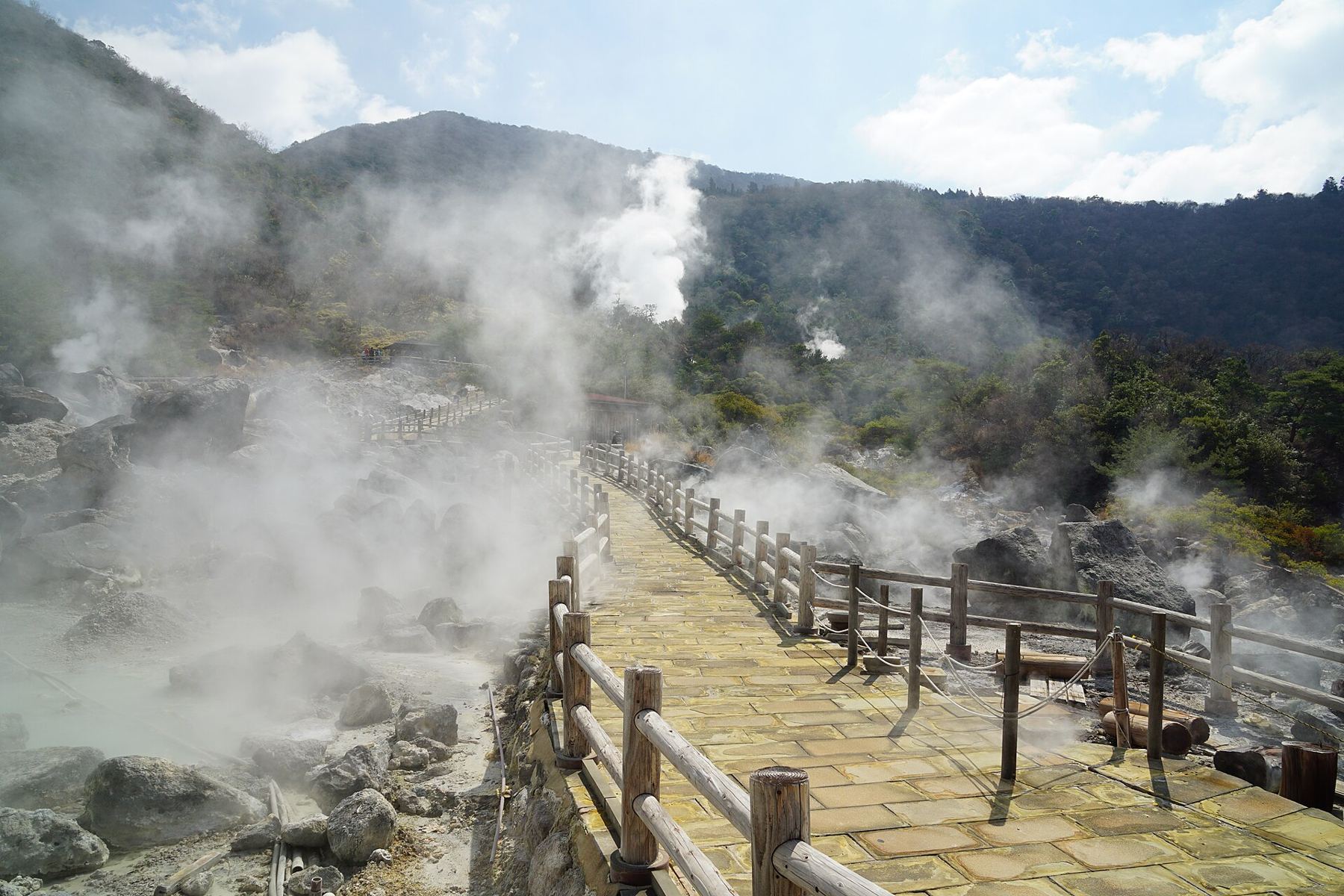
Steam and sulphurous gas rise from more than thirty vents here, each one called a , a "hell". It was here, the Japan Tourism Agency says, that the lord of Shimabara, , had the idea of using the boiling water against the Christians of his domain. At first they were boiled to death in the pools; later boiling water was poured, little by little, into cuts in their skin to make them give up their faith. Being sent to Unzen was called , "going into the mountains".
On 17 May 1627 a second group of ten went up under Sukedayū. They had been kept in prison longer because, as village headmen, they had been ordered to write out their lord's property accounts first, and they did it with their cut hands. Among them was Paulo Onizuka, aged 64, headman of Hachirao village, father of Blessed Pedro Onizuka.
the Japan Tourism Agency and the Unzen tourist association count 33 martyrs between 1627 and 1631; the Bishops' Conference dates the martyrdoms at Unzen from 1627 to 1632. In December 1632 five missionaries were put to the ordeal of the hot water and then executed at Nishizaka in Nagasaki.
A cross among the hells
Three memorials stand above the steam. The Monument of the Sacred Flame, of 1939, is an upright stone carved with lines of poetry. the Japan Tourism Agency names the poet as Ikuta Chōsuke; the Unzen tourist association credits Tokutomi Sohō. A cross of 1961 bears the names of six Japanese martyrs of Unzen beatified by Pius IX in 1867. A tablet cut in a rock in 2011 names the Unzen martyrs among the 188 beatified by Benedict XVI in 2008. another Japan Tourism Agency text dates the martyrs' monument to the Meiji era.
Every year on the third Sunday of May the Archdiocese of Nagasaki holds the Unzen martyrdom festival, with a Mass and a pilgrimage up to the monument. Below the mountain, at Fudanohara, a red brick church was founded in 1981 in honour of Blessed and his companions, martyred here, and of the Pope's visit to Nagasaki that year.
Shūsaku Endō's novel Silence and Martin Scorsese's film of 2016 open with this scene: the apostate priest watching Japanese Christians tortured at the hot springs. one tourism text says the scene was in fact shot at Gengziping hot spring in Taiwan; another says scenes were shot at Unzen.
