The clock and the spectacles
In early November 1550 Xavier reached Yamaguchi, the rich seat of . He asked to see the lord, and the audience went badly. The parish history says that the shabbily dressed Xavier angered Yoshitaka with his teaching and was sent away in the middle of it. Schurhammer adds that the lord was offended when Xavier's companion read out a passage condemning sodomy.
Xavier walked on to Kyoto and found the city in ruins. In April 1551 he came back to Yamaguchi. This time he came in good clothes, as an envoy, with letters from Goa and thirteen gifts. Schurhammer's list includes a clock that struck the hours, a pair of spectacles, a mirror, Portuguese wine, pictures and books. The parish gives a longer list that it says has been handed down, including a music box, a gun and a telescope.
The Jesuit historian John Laures, writing for the four hundredth anniversary, counts the same thirteen gifts: an ornamented clock, a music box, a finely made rifle with three barrels, spectacles, a mirror, gold brocade and other cloth, Portuguese wine, tea cups, books and pictures. The lord offered gold and silver in return. Xavier took none of it, and asked only for leave to preach. Official notices went up in the streets saying the lord was glad to have the Law of God taught, that anyone might accept it, and that whoever harmed the preachers would be punished.
Yoshitaka was pleased. He gave written leave to preach and handed the party a temple that had fallen empty, . The parish calls it the first permanent church in Japan, and says Yamaguchi was where Christmas was first kept in Japan.
Sources: the clock and the spectacles
The Jesuit letters, as told by Schurhammer, and the history published by the Yamaguchi parish.
Deus, not Dainichi
In Yamaguchi Xavier also changed his word for God. At Kagoshima his interpreter had used , the cosmic Buddha of the Shingon school. Once Xavier understood what that meant, he went through the streets with Brother Juan Fernández crying "Do not pray to Dainichi!", and from then on used the Latin Deus. In two months about five hundred people were baptised; the town then had about 50,000 people. Laures tells how crowds came to the house from morning to night, first asking about the shape of the earth, comets, thunder and rain, and then about God; Xavier wrote that it was "something almost incredible to hear the Law of God discussed in almost all the houses in such a large city". Father Cosme de Torres, Xavier's fellow worker, believed that most of these Christians "would be ready to suffer any hardship rather than give up their faith". One was a half-blind wandering singer, baptised , who became one of the great Japanese preachers of the mission.
Damian
After Xavier left, the missionaries stayed. In 1557 the Mōri attacked the Ōuchi, the town was burned and Daidōji with it. The land was given back to the priests in 1586, but the next year Hideyoshi expelled the missionaries and the Jesuits left for Hirado.
Then a blind man held the church together. was born in Sakai around 1560 and travelled as a , a blind lute player, before settling in Yamaguchi, where he was baptised at 25. With no priest he visited the believers, baptised children and led funerals.
In 1605 the lord Mōri Terumoto moved against the Christian leaders. On 16 August the samurai Melchior Motonao was executed at Hagi. On the night of the 19th Mōri's officials told Damian to come with them to Yuda on business. On the way he stopped and said this was not the road to Yuda but to the execution ground, and that for a blind man the road was bright even at night. He knelt and prayed, and was beheaded at the Ippon-matsu execution ground. His relics went to Macao in 1614 and came back to Japan in 1995. He was beatified in Nagasaki on 24 November 2008, number 13 on the bishops' list of the 188 martyrs.
Two white towers
After the ban the Paris missionaries came to Yamaguchi, and in 1893 Father found the site of Daidōji, marked on an old map he found in the backing paper of sliding doors. The site is now Xavier Memorial Park, with a monument.
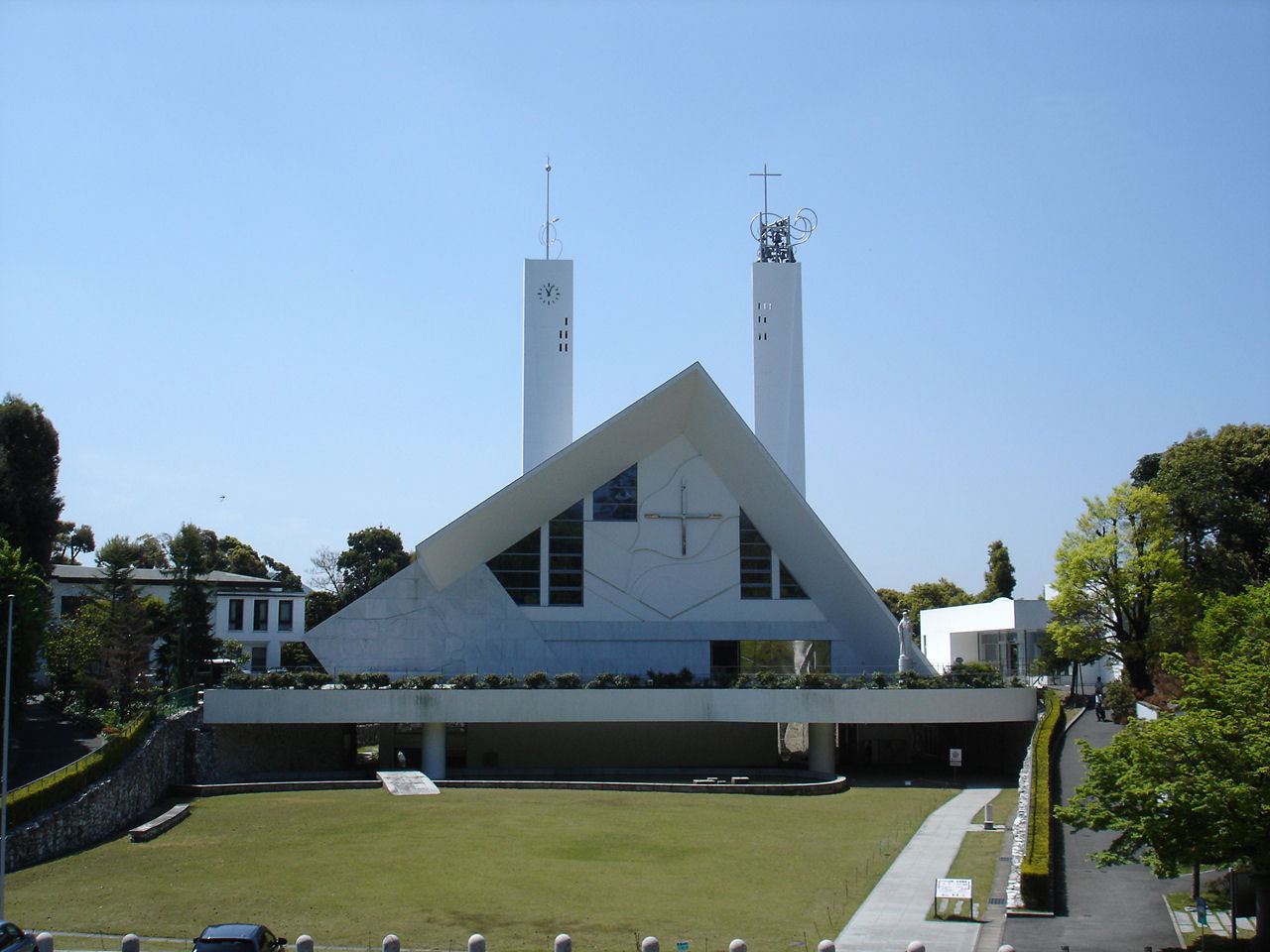
The Jesuits bought the land on Kameyama hill in July 1948, and on the 400th anniversary of Xavier's coming, in October 1952, the Xavier Memorial Church was dedicated. On the night of 5 September 1991 it burned. The present church, with its two white bell towers, was dedicated on 29 April 1998. In August 2007 a monument to Damian was set up in front of it.
