Confession before the feast
The Feast of the Assumption, 15 August, was one of 's great days. By long custom, before a major feast the parish heard confessions district by district, each on its own day.
On the morning of 9 August 1945 it was such a day. The parish priest, Father Nishida Saburō, was about to enter the cathedral, and his assistant, Father Tamaya Fusakichi, was already in the confessional. Some tens of parishioners were probably inside.
At 11:02 a.m. an atomic bomb exploded about 500 metres above Matsuyama-machi in Urakami.The cathedral collapsed. Both priests and the people with them died at once, and the ruins caught fire.
The bomb fell on the most Christian place in Japan, at the hour its people were preparing for the feast of Mary. What they did next, a Mass in a basement, a bell on three logs, a church built with their own timber, is the last chapter of the Urakami story and the beginning of the one that continues today: every 9 August, the Archdiocese of Nagasaki holds a Mass at Urakami and a torchlight procession to the hypocenter.
What was lost
Urakami's people had waited seven generations for freedom of worship, been exiled for it in 1870, and come home in 1873. On the old headman's estate where they had once been made to tread on the , they built a brick cathedral over some twenty years, finishing it in 1914 or 1915 (the Church Trust gives completion on 17 March 1914, the parish the dedication on 18 March 1915: Disputed) and adding its twin towers, 26 metres high, in 1925.In its day it was proudly called "the finest in the East."
The bomb blew off the bell-tower domes and left only parts of the side walls standing.The right tower fell straight down; the left fell almost whole into the stream below the church, where it still lies.Of the 84 angels, 33 lions and 14 saints carved in stone on the walls, about twenty angels, two or three lions and three saints survived.
The human loss was far greater. Of about 240,000 people in , about 74,000 died. Of Urakami's roughly 12,000 Catholics, about 8,500 were killed, Archbishop Nakamura Michiaki said at the 80th anniversary Mass in 2025.Figures for both are estimates and vary by source ( in detail).
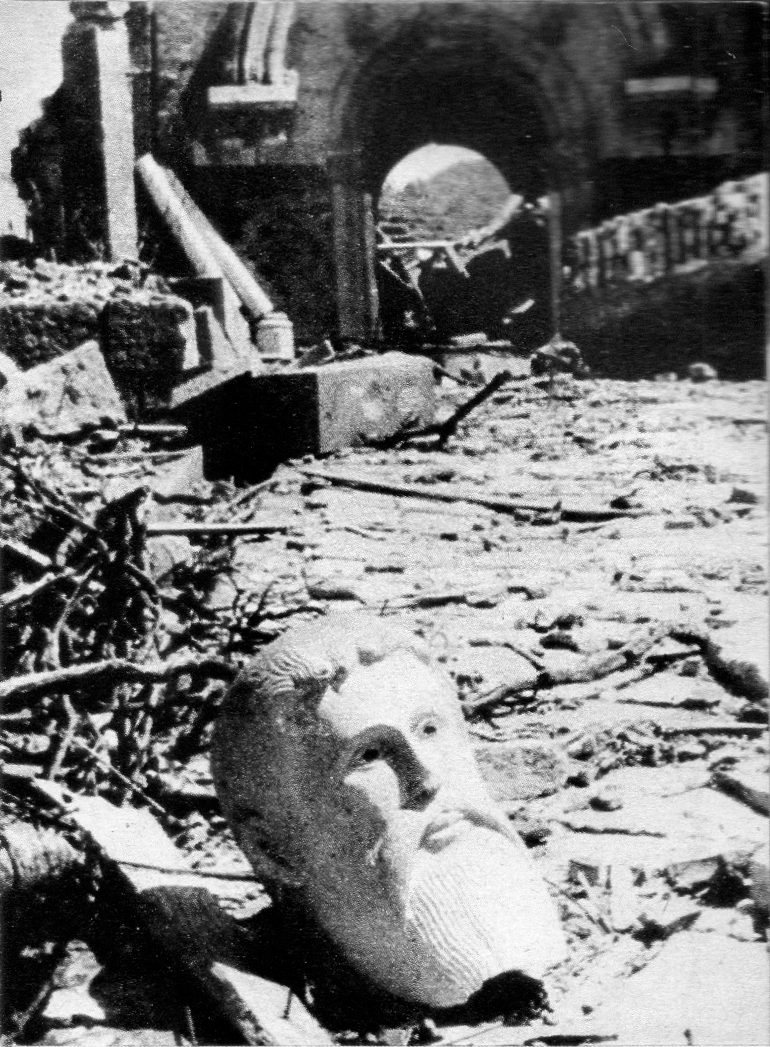
From the rubble came the wooden head of a statue of Mary, charred, with empty eyes: the "bombed Mary," Hibaku no Maria. Above the ruined main doorway, a figure of Christ on the cross also survived, headless, with one arm and both legs gone.
Mass in a hospital basement
For weeks the few survivors cleared ashes, built shacks "a little bigger than kennels," and looked for food. They assumed there would be no Mass.
Then one day in September word came that Mass would be said in the ruins of St Francis Hospital. A 20-tsubo room on the ground floor, whose concrete ceiling and walls still stood, became Urakami's temporary church. By October, with evacuees, demobilised soldiers and people returning from overseas, it was too small, and Sunday Mass moved to a half-basement on the south side, the seminary's former indoor gym.
On 23 November 1945 about 600 surviving parishioners gathered in front of the cathedral ruins for a requiem. Bishop Urakawa Wasaburō presided. In his sermon he said that their parents, brothers, husbands, wives, children and friends, "all good people," had been called to God by a single bomb. When their ancestors came home from exile in 1873, he said, they had come back to shacks, but there were still houses in Urakami; now there was not one. Everyone present, the parish history says, wept aloud.After the Mass, Dr , in rags and sick with radiation illness, read a eulogy.
The bell
The cathedral's great bell had been dug out of the rubble almost undamaged; the small bell was shattered.Nagai wanted to ring it. Bells had been forbidden; now, he thought, the faith was free and peace had come, and the sound might give the survivors the will to rebuild.
With the parish priest's consent, a young man named Yamada Ichitarō gathered helpers. On the afternoon of 24 December 1945 they found a chain hoist in the ruins of the presbytery and dug the bell free while Nagai stood nearby leaning on his stick, praying the rosary. At about the time of the Angelus they said the prayer together and struck the bell. Christians scattered nearby, hearing it for the first time in years, came running.Hung from three logs, the bell rang over Urakami that Christmas night.
The first building
In June 1946 the parish set up a building committee. Priest and people went into the hills to cut and carry timber, from the far side of the slopes, because everything facing Urakami had burned.On 1 December 1946 Cardinal Gilroy, visiting Nagasaki, blessed the new temporary church, 171 tsubo in floor area. It was, the parish history says, the first public building rebuilt in the bombed area, and the people of Nagasaki were astonished.A steel bell tower followed that December; this, the parish says, was the model for Nagai's The Bells of Nagasaki.
The young people of the parish cleared the rubble by hand from 1946 to 1949. The fallen left tower, about ten tonnes, could not be moved; explosives were banned by the occupation authorities, so the parish diverted the stream and built the tower into the new retaining wall where it lay.On 15 November 1948 the parish youth planted 1,000 cherry saplings given by Nagai.
A new cathedral was built in 1959.The remaining ruins were taken down; parts of the old church, including two stone saints and seventeen angels, were set into the new façade.
Freedom, and its price
Real religious freedom came in the same months. The of 15 December 1945 separated religion from the state, and the 1946 Constitution guaranteed "freedom of religion" to all.The freedom Urakami had waited for since 1614 arrived together with its near destruction.
