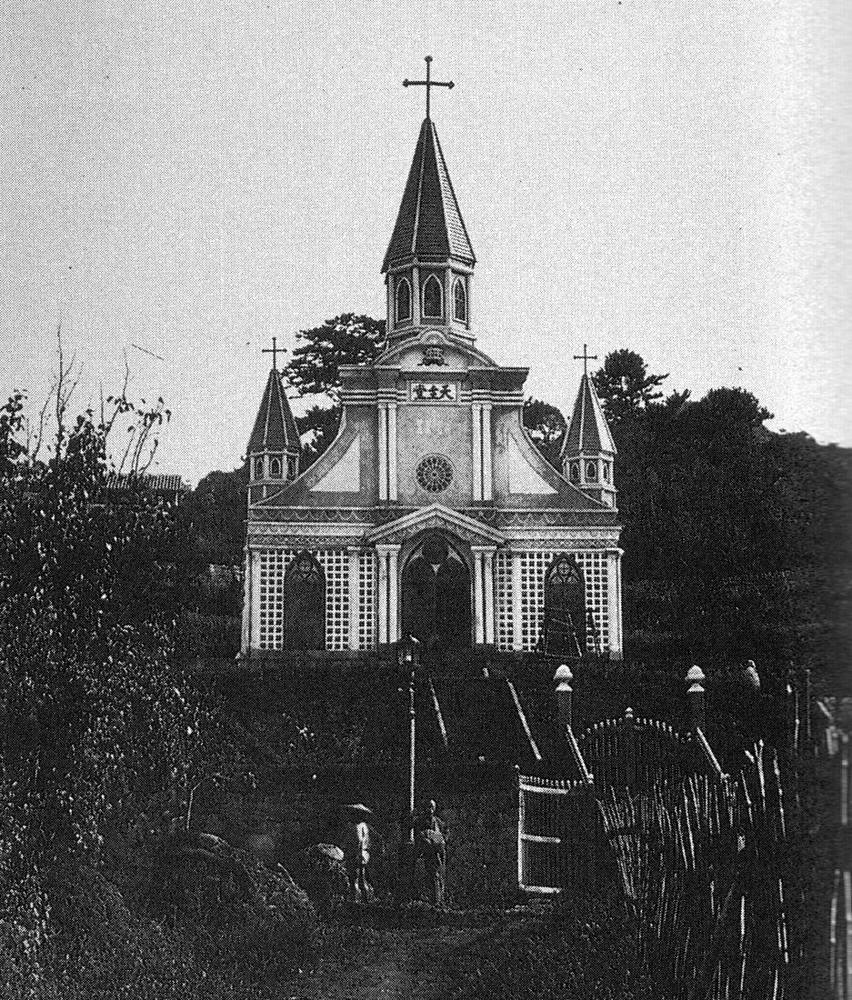
Shortly after noon on Friday 17 March 1865, a group of twelve to fifteen men, women and children stood at the shut door of the new church on the hill at in Nagasaki. Father Bernard of the Paris Foreign Missions Society went down, opened it and walked toward the altar. They followed him in.
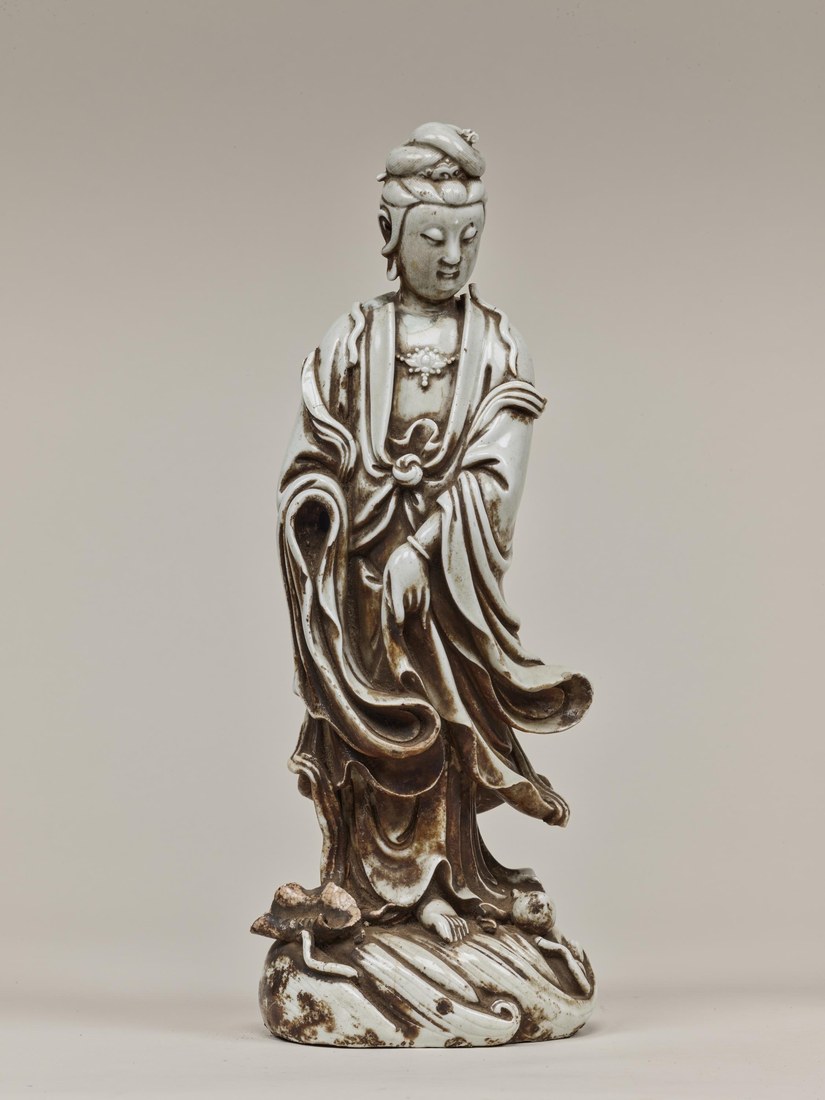
He knelt to pray. Before he had finished an Our Father, three women of fifty or sixty knelt beside him, and one of them put her hand on her breast and said very quietly, as if afraid the walls might hear: "The heart of all of us here is the same as yours." They were from , she said, where almost everyone had the same heart. And then, at once: "Sancta Maria no gozō wa doko?" Where is the image of Holy Mary?
At that name, Petitjean wrote, he had no more doubt. The woman is identified in later accounts as Isabelina , a midwife of Urakami born in 1813. Petitjean did not record her name; it comes from a later diary (Unverified).
Read the article →
This chapter begins where that story ends. It asks what happened to the people who stopped pretending.
A church built to be found
The treaties of 1858 opened Nagasaki, Yokohama and Hakodate the following year. Foreigners in the settlements could worship, and the Paris Foreign Missions Society, to which Rome had entrusted Japan, sent priests. Louis Furet reached Nagasaki in 1863, and Petitjean followed. Their church at Ōura was completed on 29 December 1864 and dedicated on 19 February 1865 to the of 1597. a Nagasaki feature dates the completion to November 1864.
On paper it was a church for foreigners; local people called it the "French temple". But over the door the priests set the Japanese word , "church of the Lord of Heaven", where any passer-by could read it. The missionaries' real hope was to find the descendants of the old Christians. The sign was a message in a bottle. It took about a month to be answered.
A week of names
The villagers tested the priest as carefully as he tested them. Did he keep the feasts they kept? They asked about the "time of sorrow", which he understood to be Lent, and the birth of Jesus on the 25th day of the frost month. The calendar they followed, by Tradition the calendar of the catechist , had been kept for more than two hundred years without a priest.
Over the next days they came in crowds. They gave the priests the most carefully kept thing they had: their baptismal names. "My husband is Paolo, my son here is Petoro, and I am Marina." On 23 March a man named Tokuzō told the priests that baptism had never stopped in Urakami. The baptiser was , the only one to survive the 1856 raid; on 18 April Petitjean met him in a wood and heard him recite the Latin formula almost exactly.
Sources: a week of names
Most of what we know of these days comes from Petitjean's letters of 18 and 22 March 1865, quoted day by day by the society's historian Francisque Marnas in 1897. The Urakami parish history and the parish add the Japanese side. Translations here are ours and should be checked against the originals.
Four secret chapels
Over the next two years the villagers built : the Chapel of Holy Mary of the Epiphany at Hara, the Chapel of Saint Joseph at Tsuji, the Santa Clara chapel at Kawakami, and the Chapel of Saint Francis Xavier on the Nagayo road in Nakano. The priests came from Ōura at night, in disguise, to teach, baptise and say Mass.
Then, in April 1867, families began burying their dead themselves, without calling the Buddhist priest of the Shōtokuji. Most of the village went to the headman and said that they had been Buddhists only on the surface. More than 400 households submitted papers refusing temple registration, the system the shogunate had enforced for two and a half centuries. The parish history calls it "a bombshell of resistance".
The night raid
The magistrate's men struck at all four chapels in the early hours of 15 July 1867. the parish history gives one in the morning for the main raid; the archbishop's 2018 homily gives about three o'clock.
In the Xavier chapel, a young man named took down the holy pictures, stacked them neatly, knelt before the officers, put his hands behind his back and said, "Please tie me." He was so calm that the officers, half believing in Christian magic, hesitated to touch him. Sixty-eight men and women were taken to prison. Under torture all but one, , renounced their faith, though after they went home they took it back. This was the fourth Urakami crackdown, the Yonban Kuzure. The French, Prussian and American representatives protested.
The journey
The shogunate fell before it settled the case. In 1868 the new Meiji government put up its own notice boards: "The evil sect of Kirishitan is strictly prohibited." It adopted a plan by Kido Takayoshi: punish the leaders and disperse everyone else among the domains.
In July 1868, 114 leaders were sent away: 66 to Hagi, 28 to Tsuwano and the rest to Fukuyama. As their steamer passed below Ōura, they turned toward its cross and said the Our Father together. In January 1870 the rest of the village followed. Many walked out in falling snow wearing the white cloth of their baptism, which they called "the veil of the soul". In all 3,394 people left, and Urakami was empty. the archbishop gives about 3,380 people sent to twenty domains at twenty-two places; Miyazaki gives about 3,300 to twenty-one domains. They called it the , the journey.
One small group of 117 was put on Tsurushima, an uninhabited island off Okayama, for three and a half years. They cleared land and grew soybeans, wheat and sweet potatoes they were not allowed to eat. Eighteen who died are buried on its hillside.
The exile caused an international outcry. The envoys of Britain, the United States, France and Germany protested together. In a formal reply, Japanese delegates said the Kirishitan openly scorned the emperor and Japanese religion, would not visit the shrines of the Sun Goddess Amaterasu or pass under a torii, and refused to keep a household Shinto shelf or a Buddhist altar; therefore, they concluded, the Kirishitan warranted persecution. The question of shrines and loyalty would come back in the 1930s, as Chapter IV tells.
Tsuwano and Wakayama
At Tsuwano, in the mountains of Shimane, Jinzaburō and Sen'emon were pushed into an icy pond in the snow. Told to come out, Jinzaburō answered: "I am climbing a mountain of treasure now. I can't come out of this pond." at Tsuwano. The Tsuwano parish names them all, among them Moriyama Yūjirō, fourteen, who after days of beatings saw a sparrow feeding its chick and took courage; and Iwanaga Mori, six, who refused an officer's sweets.
, a mother of four sent to Wakayama, remembered praying the rosary aloud through the streets of Nagasaki as they were led away, and then a stable with no light. "We could not tell if a dying person was still breathing. We felt with our fingertips and listened for breath, and did the last prayers in the dark."
How many died in all? The parish history counts 613 deaths and 1,011 who renounced, most of whom later returned to the faith. Miyazaki gives 664, and other sources about 660 or 662.
A notice about notices
Japan's leaders, touring the West on the Iwakura mission, heard about Urakami wherever they went. On the government issued Dajōkan Proclamation No. 68, ordering the old notice boards taken down. It never proclaimed religious freedom; Christianity was tolerated by silence. On 14 March the exiles were ordered home.
The first fifty-three arrived from Wakayama on 7 April 1873; about 1,900 came back in all, and 736 of them had no house to go to. They ate worm-ridden dried sweet potato and dug their fields with broken pottery. "But it was not hard," Sada remembered. "It was far better than the journey. We could work freely, and we could pray aloud."
Seven generations, Bastian's prophecy had said, and then they would sing their prayers aloud. They had paid for it with six years and more than six hundred lives. In 1880 they bought the headman's house where their families had trodden on the fumi-e every New Year, and began to build a church there. That is Chapter IV.