In the ashes
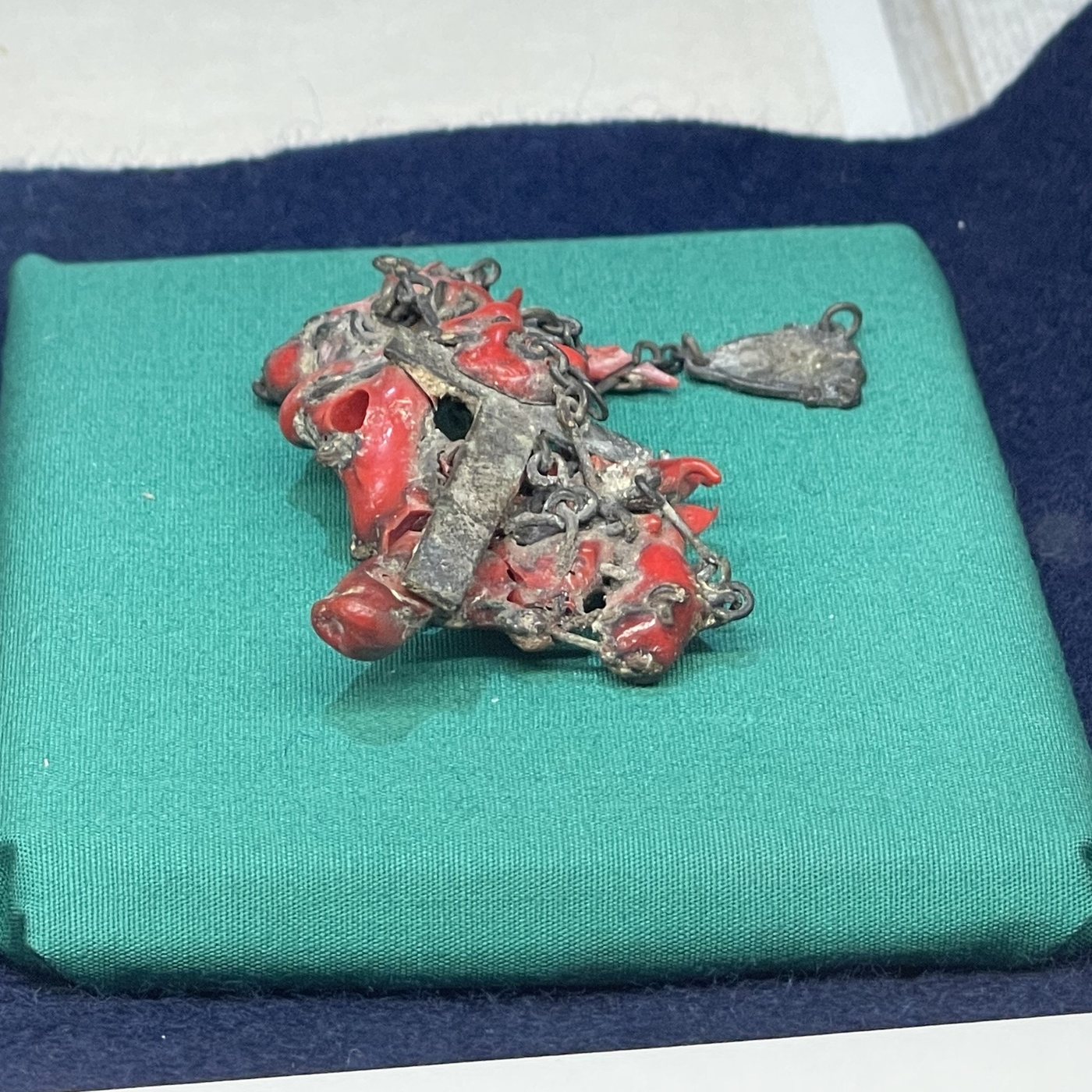
"On the third day, when the dead and wounded among the students had been dealt with, I went home in the evening. There was nothing but ash. I found it at once: a black mass where the kitchen had been. It was what was left of the pelvis and the lower spine, burned through. Beside it lay the chain of a rosary, with its cross."4
Nagai Takashi wrote these lines about his wife Midori in the title essay of Rosario no kusari, The Chain of the Rosary.4
August 1945
Midori came from an Urakami family that had kept the hidden Christian faith for seven generations, and she married Nagai Takashi in August 1934.9,6 On August 9, 1945, she was at home in Urakami; the children, Makoto and Kayano, had been sent with their grandmother Moriyama Tsumo to Mitsuyama in the hills.7 Nagai was badly cut at the medical college, about a kilometer from the house, and stayed with the wounded there.4
The third day was August 11.6 He gathered her bones into a burnt bucket and carried them to the grave.4 His autobiographical novel Horobinu mono o says he buried her between the graves of two of their children who had died as infants.5
The chain of the rosary
Nagai told the story in the title essay of 『ロザリオの鎖』 (Rozario no kusari), whose preface he signed on March 25, 1948, as "a dweller of Urakami, Nagasaki"; the book came out that June.4,6 He named the book after that chain.4
Note This is not the rosary that the Pope sent Nagai in 1950 through the papal envoy, Archbishop Furstenberg.6
At the museum
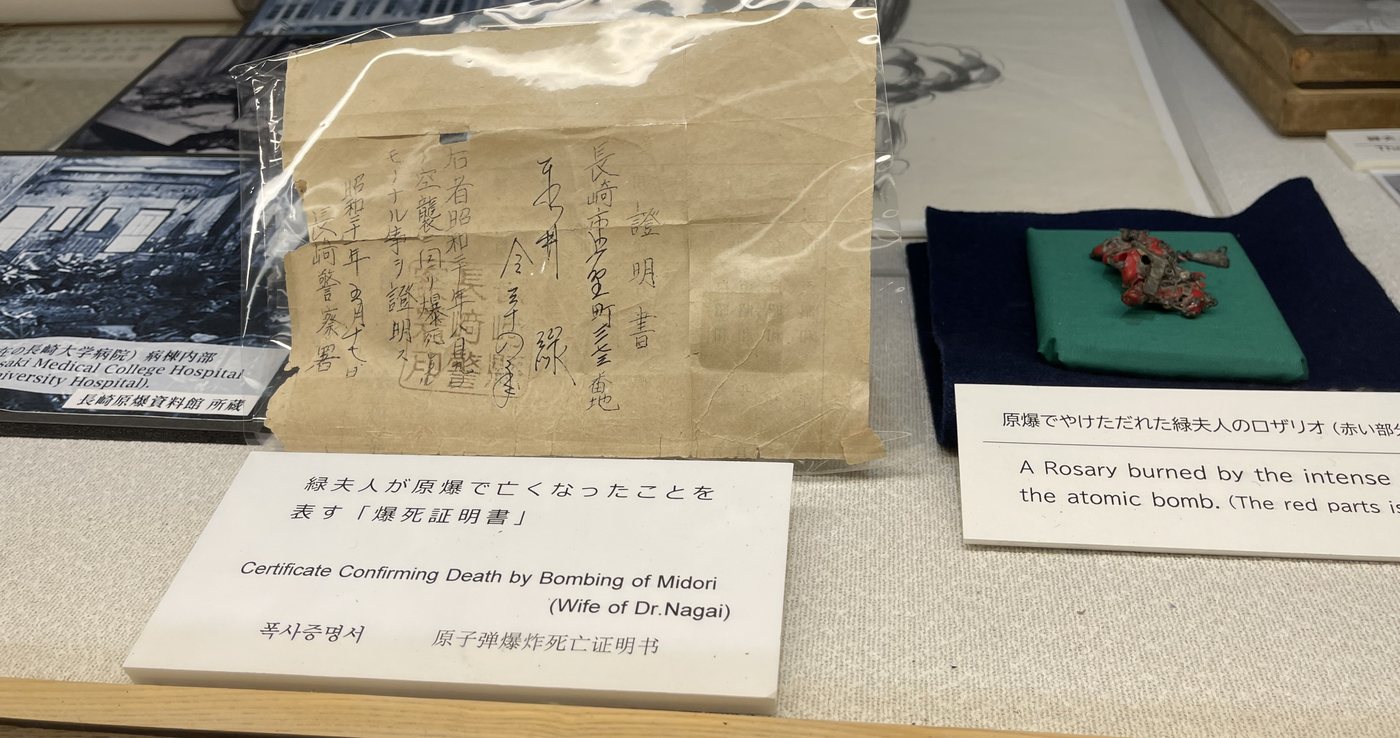
The museum built beside his last home keeps that rosary today. Its exhibition calls it "the rosary left by his late wife Midori" (亡くなった妻 緑の形見のロザリオ); 形見 (katami) is a keepsake of someone who has died.7
The label in the case, in Japanese and English, calls it 「原爆で焼けただれた緑夫人のロザリオ」, Mrs Midori's rosary burned by the atomic bomb, and notes that the red parts are coral (赤い部分はサンゴ).1
In the same case are the certificate recording her death in the bombing (爆死証明書) and the hand mirror she used.2 A panel nearby quotes the account of Urata Tatsue from 『私たちは長崎にいた』 (We of Nagasaki).3
The museum grew out of the children's library Nagai opened in 1950. It became the Nagasaki City Nagai Library in December 1952, was renamed the Nagai Memorial Hall in 1969, and reopened in April 2000 as the Nagasaki City Nagai Takashi Memorial Museum, with Nyokodō beside it.8