Walls on a hill
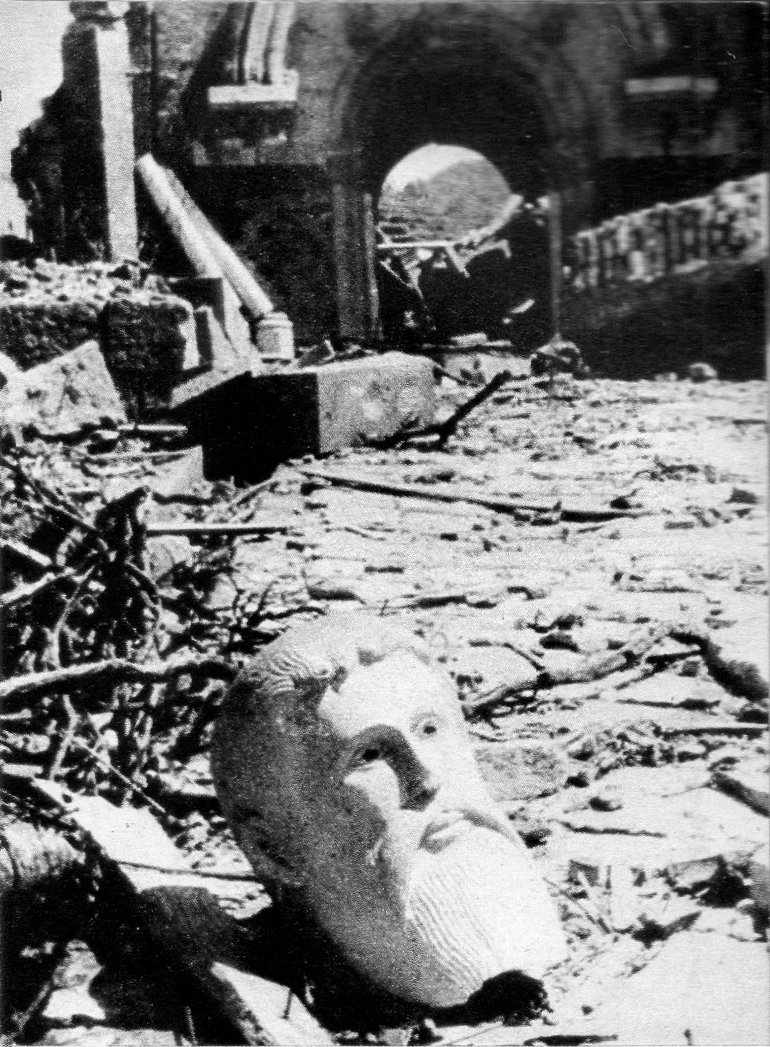
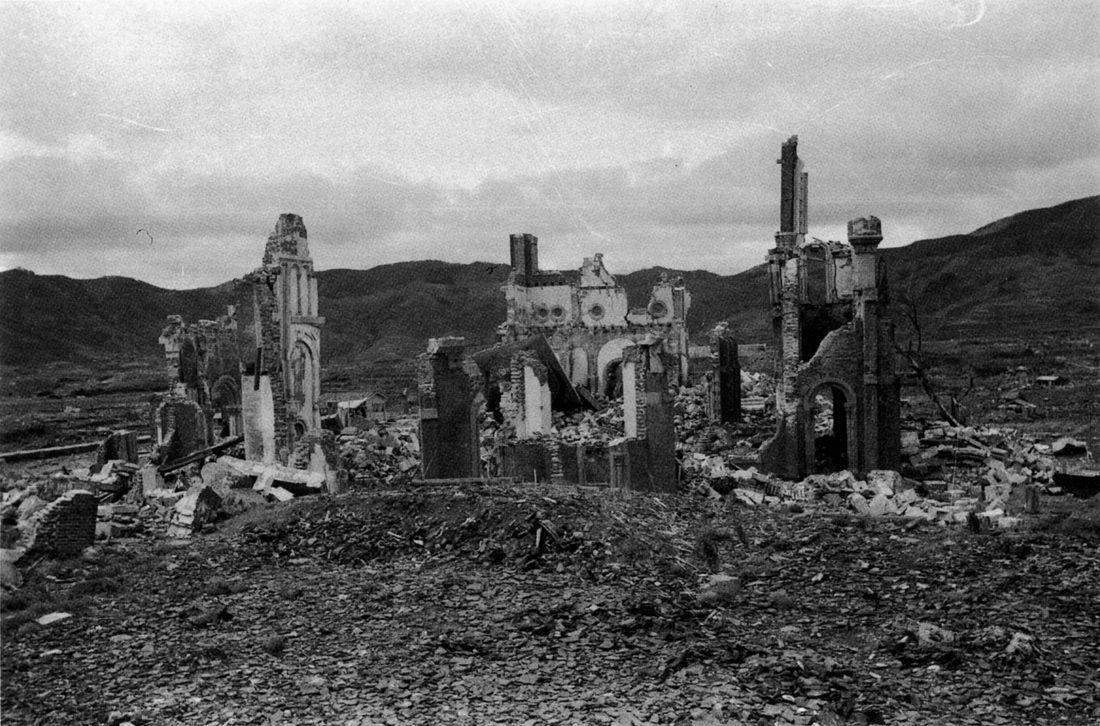
At 11:02 on 9 August 1945 a plutonium bomb exploded over the Urakami valley. The cathedral stood on a low hill about 500 m to the northeast. The church and priests' house collapsed and burned; only parts of the walls and a bell tower were left standing. 1,2 A national feature on the bomb's anniversary reports that of about 12,000 Catholics in the Urakami area, about 8,500 died. 3
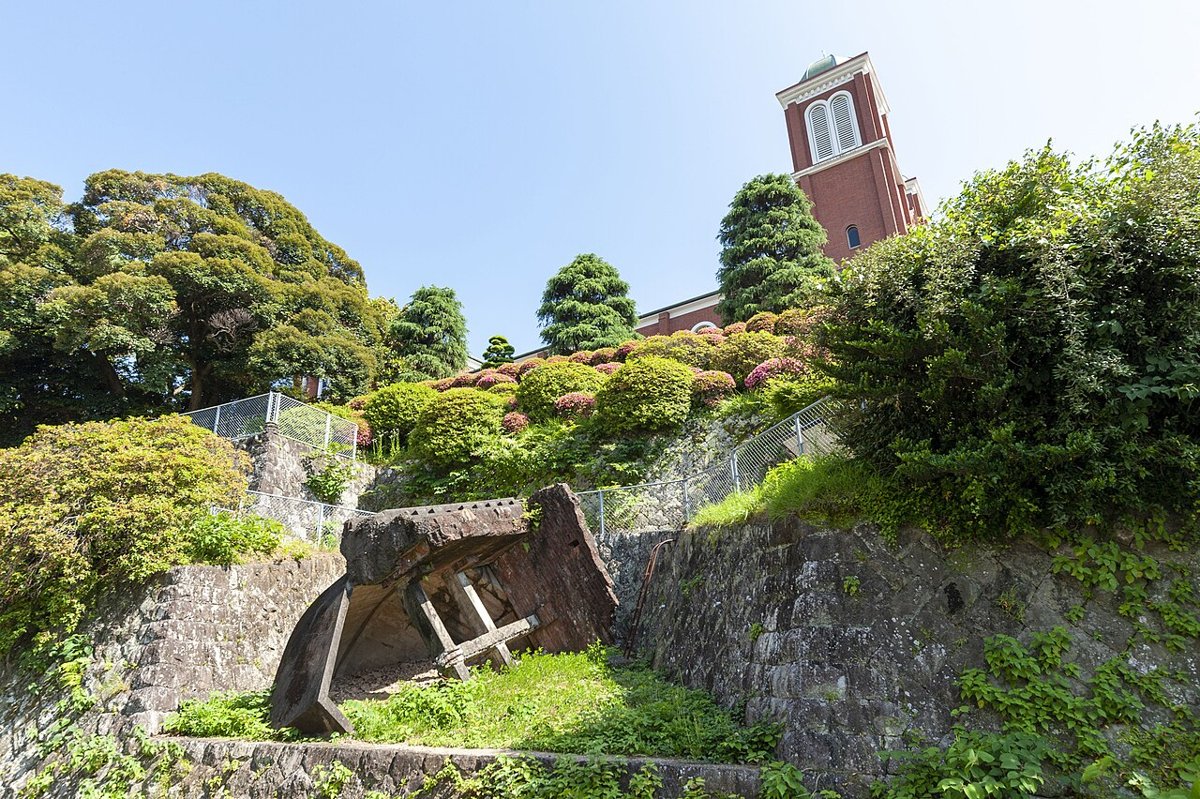
The photograph in slide 9, taken by Yamahata Yōsuke and dated spring 1946 on Commons, shows what remained: broken brick walls, stone saints still standing on the cornice, and a flattened landscape behind. 7 One bell tower fell whole into the ravine beside the church, where it still lies. 8
The parish history explains why. The left tower, about ten tonnes, had dropped into the stream beside the church, and the youth group could not move it. Blasting was impossible because the occupation forces banned all use of explosives. Father Nakashima Banri asked the landowner across the stream for a strip of land, and the stream was moved instead. The tower was left where it fell and built into the new stone retaining wall of the church grounds, which used stone from the ruined church. Some dealers bought the old bricks one by one, and the money went toward the grounds. 11
A church in the ruins
The Urakami Catholics did not wait. Carpenters among the believers formed a group and worked day and night, and in 1946 a temporary church stood on the site. 1 Historian Fukuma Yoshiaki dates it to December 1946, a single-story wooden building. By the Xavier feast of 1949 the rubble had been cleared, leaving the right front and right side walls. 4
Two kinds of memory
The parish saw things differently. With demobilized soldiers, repatriates and newcomers, the community had grown to nearly 5,000, far too many for the temporary church. In July 1954 the parish set up a reconstruction committee and raised funds, including in the United States. 4
The city's mayor, Tagawa Tsutomu, was not keen to keep the walls. At an extraordinary council session in February 1958 he said the ruins would never prove the misery of the bomb, were not essential to keeping the peace, and that he had no intention of spending large city funds to preserve them; many people, he added, felt that removing them would better serve lasting peace. 4 The council, meeting on 17 February 1958, nevertheless passed a resolution calling for the ruins to be preserved, and the preservation committee pressed the same case. 4
The committee even offered the parish another site to build on. The parish declined, because this was ground with a history going back to the age of persecution: the old headman's house where their ancestors had been made to tread on images. Demolition began on 14 March 1958. 4,6
The debate that came later
In 1958 the question drew little public attention. The local paper reported the start of demolition on an inside page, the prefectural assembly never discussed it, and the novelist Inoue Mitsuharu, who watched all three days of the work, recalled that apart from one young man on the third day, the only people there were himself and the workmen. 4
Decades later the loss became a public argument. In 2009 the journalist Takase Tsuyoshi published 『ナガサキ 消えたもう一つの「原爆ドーム」』, suggesting that American wishes played a part. He pointed to Mayor Tagawa's 1955 visit to the United States, after St. Paul, Minnesota proposed a sister-city link, and to the change in his stance afterwards. 3 Tomoe Otsuki has argued that US-Japan relations in the mid-1950s shaped the 1958 decision. 5 The director of the national peace memorial hall told a reporter in 2015 that there were many views and "the truth is unknown". 3 Disputedno source we have seen documents direct American pressure; the case rests on timing and context.
What was saved
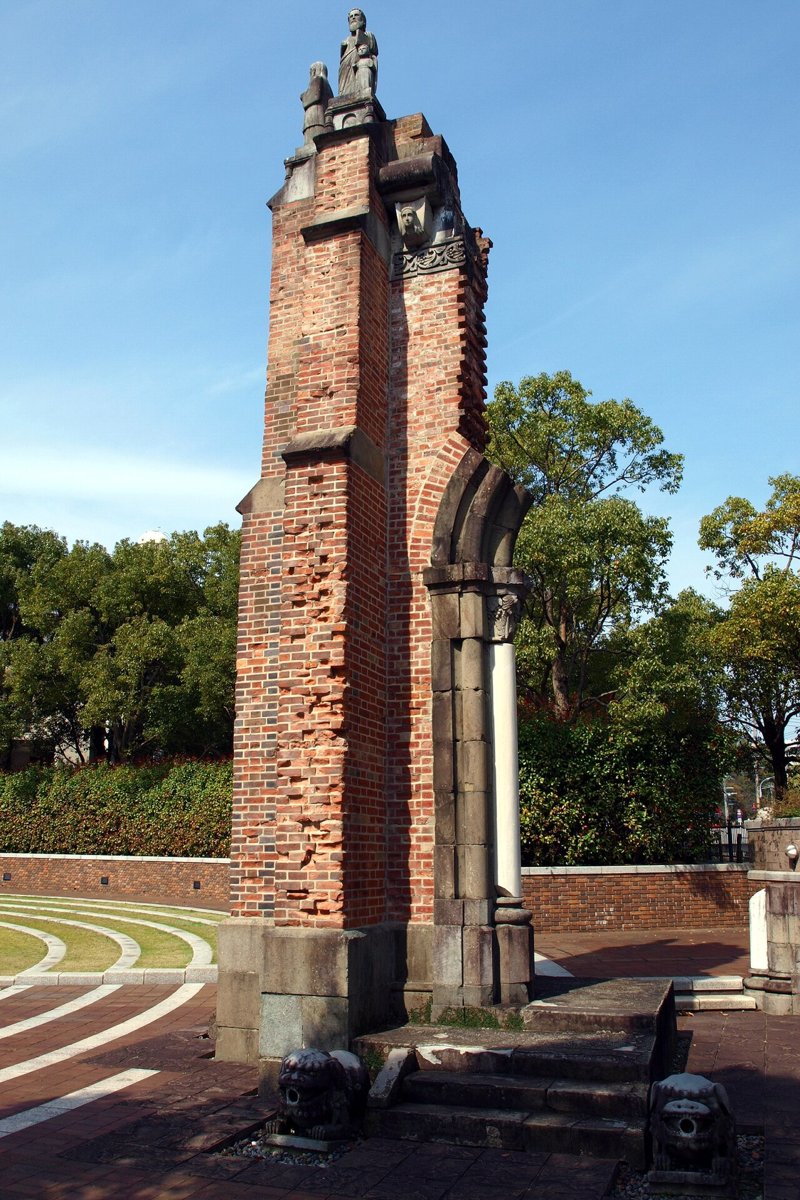
A section of the south wall, with statues the plaque identifies as Xavier and the apostles, was moved in 1958 to the hypocenter park and later reinforced. 2 The stone retaining wall of the old site still stands below the new cathedral. 9 A statue of Saint Agnes found in the ruins is now displayed at United Nations headquarters in New York. 3,10 The Nagasaki Atomic Bomb Museum shows a reconstruction of the 11 m south wall. 3 And the new cathedral rose on the old ground, completed in October 1959. 4
Slide 9 is the moment between: after the bomb, before the decision. The same people who rebuilt chose to clear what Hiroshima chose to keep. Both choices came from grief. 4