The feast of the Assumption, 15 August, was one of Urakami's great days. By long custom, before a major feast the parish heard confessions district by district, each on its own day.
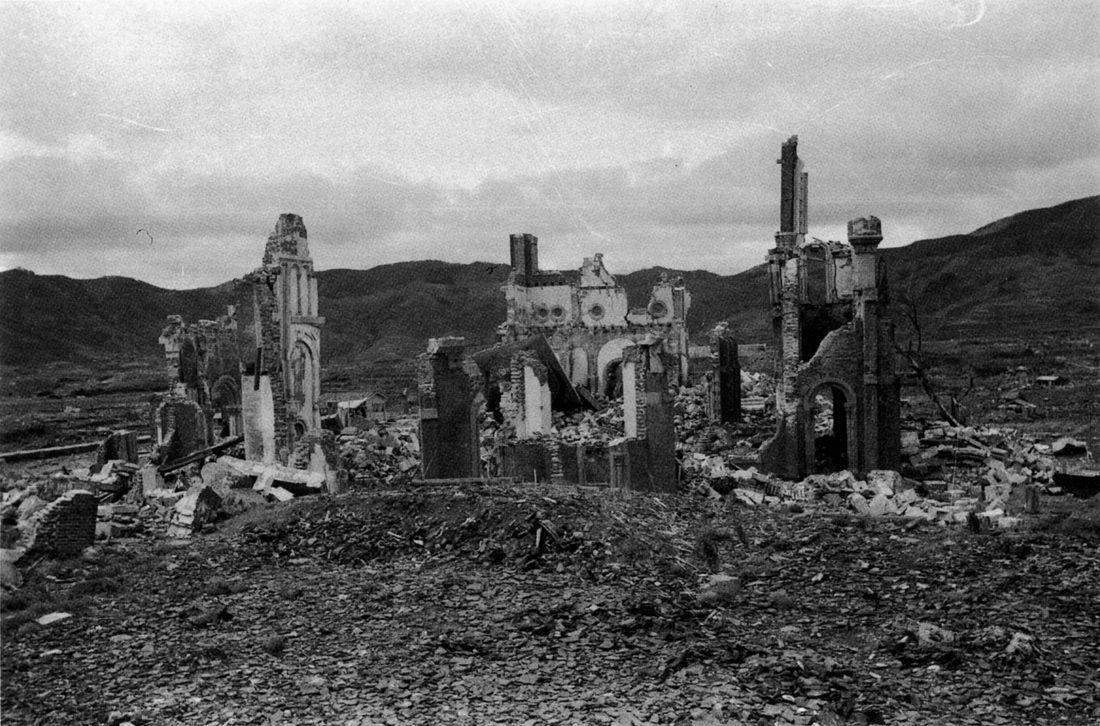
The morning of 9 August 1945 was such a day. The parish priest, Father Nishida Saburō, was about to enter the cathedral, and his assistant, Father Tamaya Fusakichi, was already in the confessional. Some tens of parishioners were probably inside. At 11:02 a.m. about 500 metres above Matsuyama-machi in Urakami. The cathedral collapsed. Both priests and the people with them died at once, and the ruins caught fire.
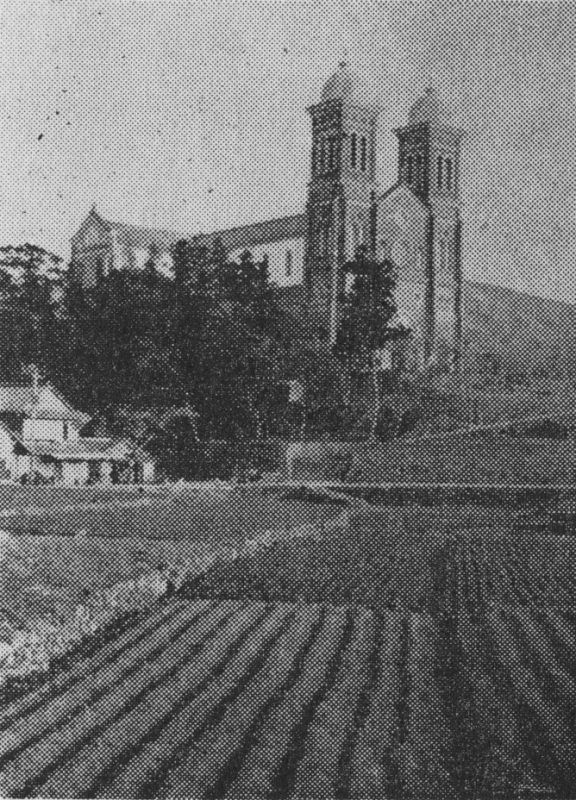
These were the grandchildren of the exiles. Their ancestors had waited seven generations to pray aloud, been driven out in 1870, come home in 1873 and spent thirty years building a cathedral on the ground where they once trod on the fumi-e.
What was lost
The bomb blew off the domes of the bell towers and left only parts of the side walls standing. One tower fell straight down; the other fell almost whole into the stream below the church, where it still lies. Of the 84 angels, 33 lions and 14 saints carved on the walls, about twenty angels, two or three lions and three saints survived.
The human loss was far greater. Of about 240,000 people in Nagasaki, about 74,000 died. Of Urakami's roughly 12,000 Catholics, about 8,500 were killed, Archbishop Nakamura Michiaki said at the 80th anniversary Mass in 2025. both figures are estimates and vary by source.
A face in the ashes
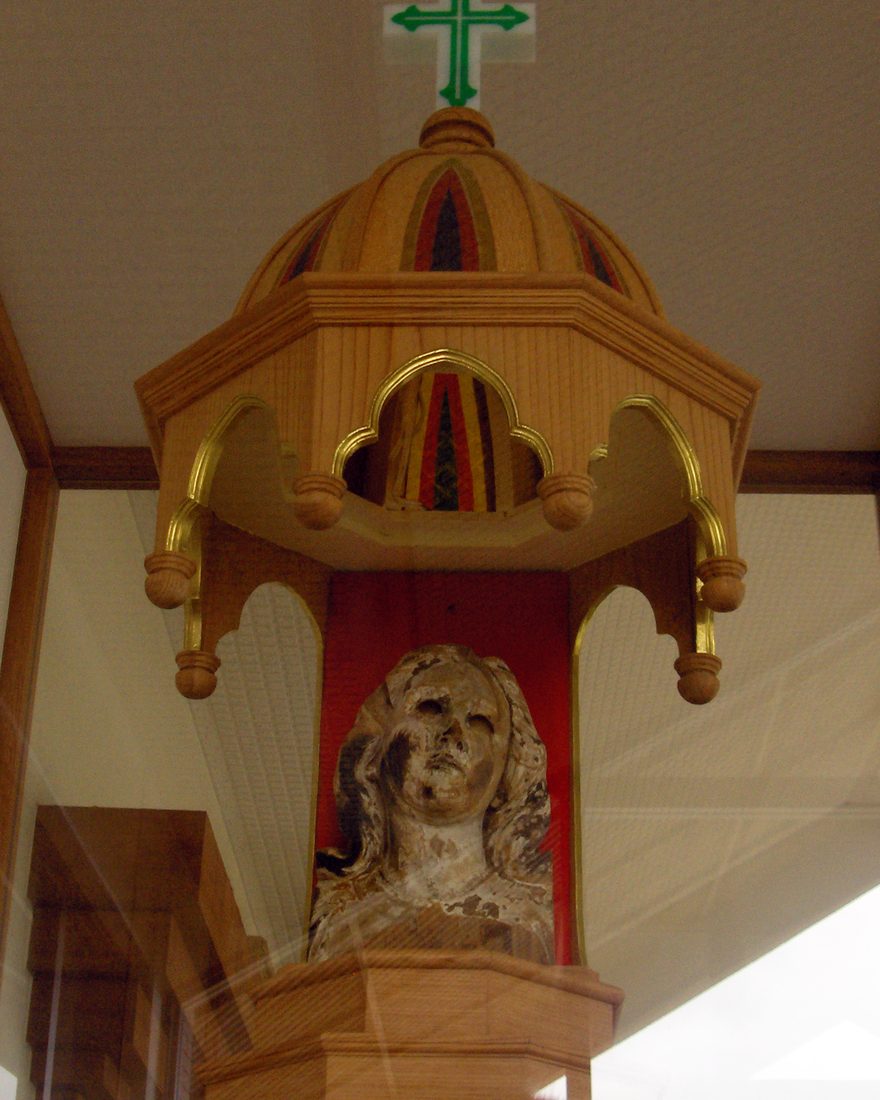
In the autumn a Trappist monk from Hokkaido, Father , who had been born in Urakami, came to the ruins. Before going back north he wanted something, anything, from the church where he had grown up. Searching near the altar he found the charred wooden head of the statue of Mary that had stood above it, her glass eyes gone. He took it to his monastery. Decades later it came home: it was shown at the Vatican in 1985, returned to Urakami in 1990, and in 2010 travelled to Guernica and to New York for the nuclear non-proliferation review conference. Since 2005 it has had its own chapel in the rebuilt cathedral: the Hibaku no Maria, the bombed Mary.
A requiem and a bell
For weeks the survivors cleared ashes and built shacks "a little bigger than kennels". They assumed there would be no Mass. Then one day in September word came that Mass would be said in the ruins of St Francis Hospital, in a ground-floor room whose concrete walls still stood. By October, with evacuees, demobilised soldiers and people returning from overseas, it was too small, and Sunday Mass moved to a half-basement that had been the seminary's indoor gym. On 23 November 1945 about 600 surviving parishioners gathered in front of the cathedral ruins for a requiem. Bishop said that their families and friends, "all good people", had been called to God by a single bomb. When their ancestors came home from exile in 1873, he said, they had come back to shacks, but there were still houses in Urakami; now there was not one. After the Mass, Dr , the radiologist baptised in 1934, now sick with radiation illness, read a eulogy. what Nagai's eulogy meant, often summarised as calling the dead a "burnt offering", is debated by historians; we do not quote it here.
The cathedral's great bell had been dug out of the rubble almost undamaged. Nagai wanted to ring it, so that the sound might give the survivors the will to rebuild. On the afternoon of 24 December 1945 a young man named Yamada Ichitarō and his helpers found a chain hoist in the ruins, raised the bell on three logs while Nagai stood by praying the rosary, and at about the time of the Angelus they struck it. Christians scattered across the burned valley, hearing it for the first time in years, came running.
Freedom arrives
The freedom Urakami had waited for since 1614 arrived in the same months as its near destruction. On 15 December 1945 the occupation's separated religion from the state. The Constitution of 1946 guaranteed freedom of religion to all, with no conditions about peace and order or the duties of subjects.
On 1 December 1946 the visiting Cardinal Gilroy blessed a new temporary church of 171 tsubo, built of timber that priest and people had cut and carried from the far side of the hills, because everything facing Urakami had burned. The parish history calls it the first public building rebuilt in the bombed area. On 15 November 1948 the parish youth planted 1,000 cherry saplings given by Nagai. From his two-mat hut, , he wrote The Bells of Nagasaki, published as a book in January 1949. Visitors came to the hut: Helen Keller on 18 October 1948, and in 1949 the papal legate, Cardinal Gilroy; that year the Emperor also received him. The hut took its name from the motto he chose for it, nyoko aijin, "love others as yourself". He died on 1 May 1951, aged 43.
The ruins question
The question of the ruins came next. On 6 October 1945, two months after the bombing, members of the city council called for them to be preserved. The city's Atomic Bomb Materials Preservation Committee later urged the same. But the community had grown to nearly 5,000, far too many for the temporary church, and in 1954 the parish began raising money to rebuild. Mayor Tagawa Tsutomu told the city council in February 1958 that he had no intention of spending large city funds to keep the walls, though the council itself passed a resolution for preservation on 17 February. The preservation committee offered the parish another site; the parish declined, because this was the ground of the old headman's house where their ancestors had been made to tread on the fumi-e. Demolition began on 14 March 1958, and the new cathedral was completed in October 1959. It happened with little public notice: the novelist Inoue Mitsuharu, who watched all three days of the work, recalled that apart from one young man on the third day, the only people there were himself and the workmen.
in 2009 the journalist Takase Tsuyoshi suggested that American wishes played a part, pointing to the mayor's 1955 visit to the United States after St. Paul, Minnesota, proposed a sister-city link; the historian Tomoe Otsuki has argued that US-Japan relations in the mid-1950s shaped the decision. No source we have seen documents direct American pressure. A section of the south wall was moved to the hypocenter park, and the fallen bell tower still lies in the stream.
Brick and glass
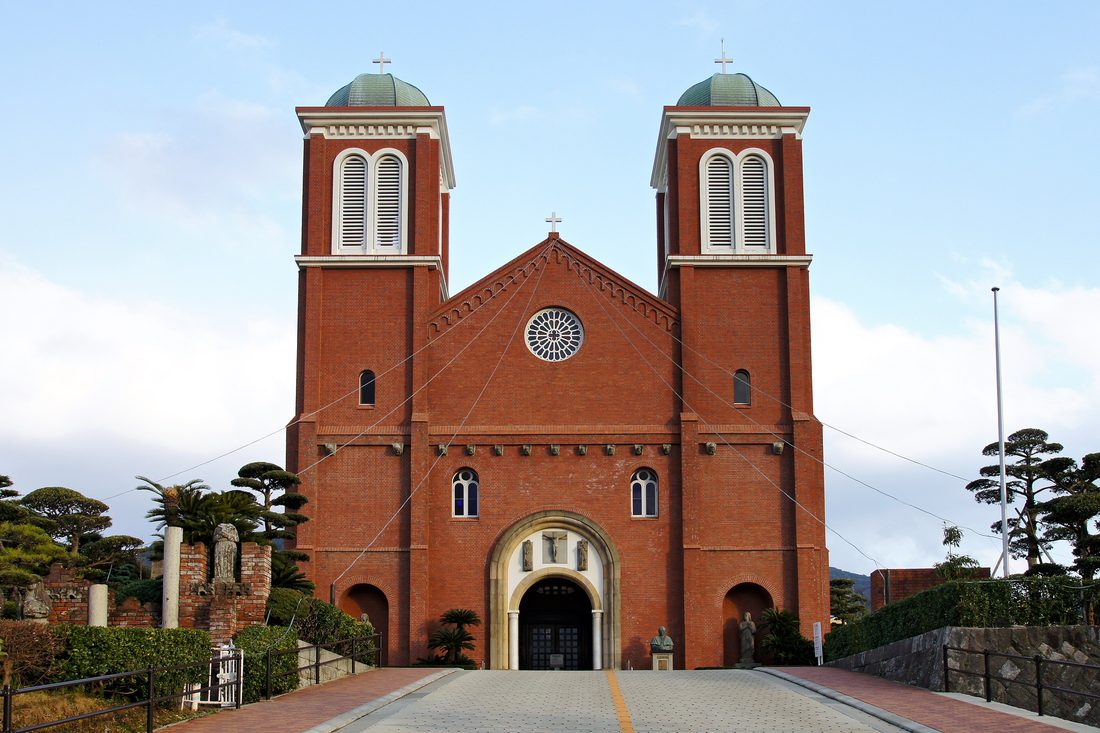
In 1959 Nagasaki became an archdiocese, and in 1962 the bishop's seat moved from Ōura to Urakami. In 1980 the concrete cathedral was faced in brick to recall the old one, and stained glass was added.
A pope in Nagasaki
In February 1981 Pope John Paul II came to Nagasaki. At six in the evening on 25 February, in Urakami Cathedral, he ordained fifteen priests. He thanked God, he said, for bringing him to "a city whose history is marked by glory and tragedy," and to the descendants of those "who achieved glory and overcame tragedy." The next morning, at the Matsuyama municipal stadium, he said a Mass for the martyrs and baptised seventy-five people. He spoke of Nishizaka as Nagasaki's Mount of Beatitudes, and of sixteen martyrs of the 1630s whom he had beatified in Manila days before.
Martyrs, heritage and a second pope
On 24 November 2008, about 30,000 people gathered in Nagasaki for the beatification of of the Edo period, the first such ceremony held in Japan. Among them was Petro Kasui Kibe, the first Japanese known to have visited Jerusalem. In 2018 UNESCO listed the Hidden Christian Sites in the Nagasaki Region as : twelve components, ten villages, the remains of Hara Castle and Ōura Cathedral, which together, UNESCO says, bear unique testimony to a tradition "nurtured by hidden Christians" who secretly passed on their faith during the ban. The listing also covers the revival of the communities after 1873, the story of Chapter IV.
On 24 November 2019 Pope Francis came. At the hypocenter park, at a quarter past ten in the morning, he recalled "the damaged cross and statue of Our Lady recently discovered in the Cathedral of Nagasaki" and said that the possession of nuclear weapons "is not the answer" to the human longing for security. Half an hour later he paid tribute to the martyrs at the monument on Nishizaka Hill, and in the afternoon he said Mass at the baseball stadium.
Small, quiet, and still passed hand to hand
Freedom did not bring crowds. At the end of 2024 Japan had 412,958 Catholics, 0.331 percent of the population; in the Archdiocese of Nagasaki they are over 4 percent. The , the descendants of the hidden Christians who never rejoined the Church, are fading too. On Ikitsuki, three of the last village groups dissolved between March 2024 and New Year 2025.
And yet the thread holds. In November 2025, at in Sotome, the 75-year-old of the Kurosaki community recited the for about thirty minutes, as the keepers before him had done. Every 9 August the Archdiocese of Nagasaki holds a Mass at Urakami and a torchlight procession to the hypocenter. And the great bell, the one Yamada and his friends raised on three logs, still hangs in the cathedral's tower.