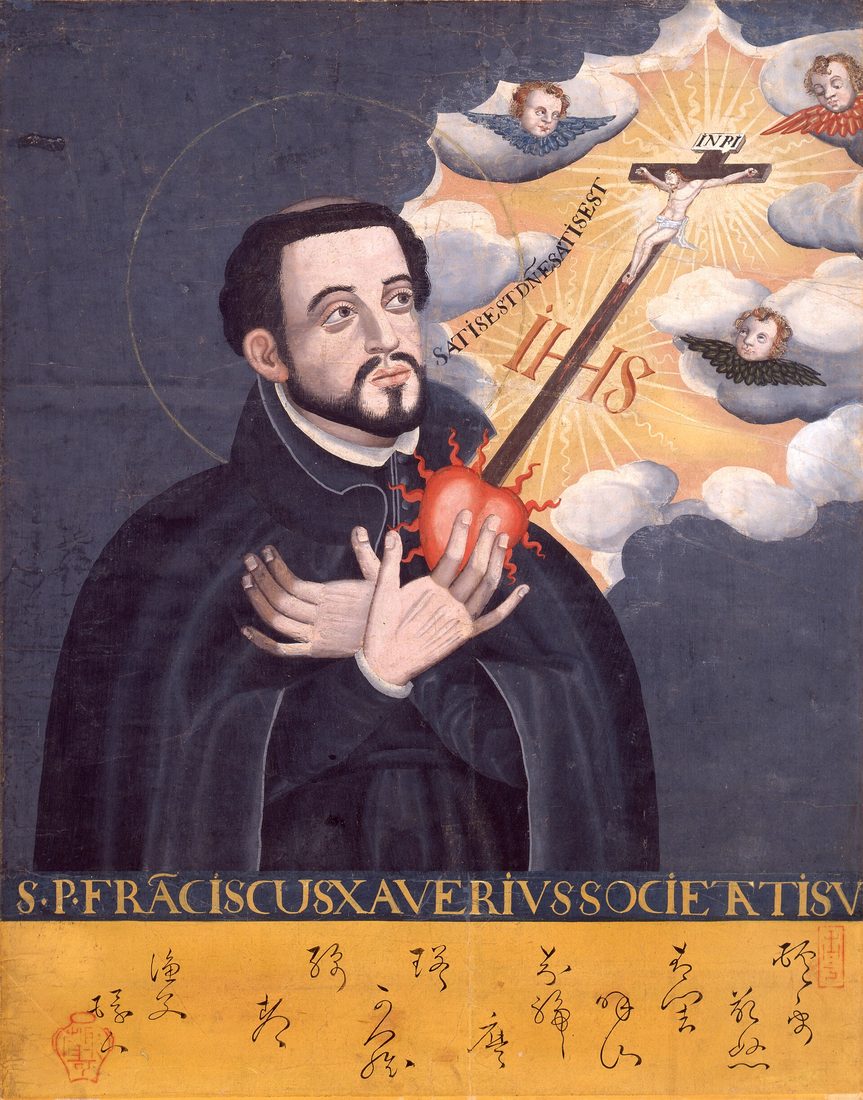
In December 1547, in the Portuguese port of Malacca, a priest was officiating at a wedding when a ship's captain he knew walked in with a stranger. The stranger was about thirty-five, a man named from , at the southern tip of Kyushu. He had fled Japan after a killing and had found his way onto a Portuguese ship. The priest was Francis Xavier, one of the founders of the Society of Jesus, and he wanted to know about Japan.
Would the Japanese become Christians, Xavier asked, if he went there? Anjirō's answer, as Xavier's biographer Georg Schurhammer tells it from the letters, was careful: "Not at once. First they will question you about many things, and they will consider what you answer and what you know, and above all they will observe whether you live up to your teachings."
The faith that came to Japan in the 16th century arrived on trading ships, and some lords welcomed it for the sake of the trade. But it took root because Japanese men and women weighed it, as Anjirō said they would, and made it their own.
The layman comes home
Anjirō was baptized at Goa at Pentecost 1548 as Paulo de Santa Fé, "Paul of the Holy Faith". Miyazaki Kentarō calls him the first Japanese Christian. On he brought Xavier, two Jesuit companions (Cosme de Torres and Juan Fernández) and two other Japanese Christians home to Kagoshima. His mother, wife and daughter welcomed them.
Xavier liked what he found. "The people whom we have met so far are the best who have as yet been discovered," he wrote. But there was a problem of language that no one could yet see. Paulo had to translate Christian ideas with the only religious words he had, and they were Buddhist. Paradise became "the Pure Land", and for God he borrowed , the cosmic Buddha of the Shingon school. "Even though Xavier thought he was urging people to worship the Christian God," Miyazaki writes, "in reality he was preaching the Buddha of Buddhism."
Xavier learned. After a hard winter journey to a half-ruined Kyoto that won him nothing, he went to as an envoy with letters and gifts, received permission to preach, and went through the streets telling people "not to worship Dainichi". From then on he used the Latin word Deus. About five hundred people were baptized there in two months, Schurhammer says. In 1550 he also gave the Kagoshima believers a church calendar, so that they could keep the feasts without a priest. Remember that calendar; it returns in the next chapter.
He left Japan in November 1551, after a little over two years. By Schurhammer's counts he left Christians behind him at Kagoshima and some five hundred at Yamaguchi, and Miyazaki notes that his Japanese never became fluent. His view of the Japanese as a people of high culture became "the basic line for future missionary work in Japan".
Lords, ships and a port
After Xavier, Torres led a small mission concentrated in Kyushu and the capital. In 1563 of western Kyushu became the first Christian ; was baptized at near Kyoto in 1564; the powerful Ōtomo Sōrin of Bungo followed in 1578, and Arima Harunobu in 1580.
Why did they convert? For some lords the Portuguese ships were part of the attraction, and Miyazaki notes that when the ships did not come to their ports, some turned against the Christians. He also doubts how well the people of whole baptized domains understood what they had joined. But he makes an exception of a few, Takayama Ukon among them. Ukon proved it: in 1614 he chose exile rather than give up his faith and died in Manila in 1615, and in 2017 the Church beatified him as a martyr.
The numbers grew fast: about 6,000 Christians ten years after Xavier, about 130,000 by 1579, about 300,000 by 1601, and by one estimate 760,000 baptized by the early 1630s in a country of perhaps twelve million. Note: these are scholarly estimates, not counts.
The port at the centre of it all was Nagasaki. In 1570 the Jesuits and the Christian lord of the area surveyed the harbour; the first Portuguese ship entered in 1571, and from then until 1639 the ships came every year. In 1580 Ōmura Sumitada gave as their fief. To fund the mission the Jesuits invested in the silk trade between Nagasaki and Macao, which brought in large profits and, later, the criticism that they were too deeply involved in business. The Jesuit historian Hubert Cieslik gives the mission's side: the support promised by the Portuguese crown came irregularly or not at all, while churches, colleges and a staff that at times reached nine hundred people had to be paid for.
Valignano's Japan
In 1579 the Jesuit visitor Alessandro Valignano arrived to take stock of thirty years of work. His answer was accommodation: missionaries must learn Japanese, understand Japanese manners and adapt their way of life, and in 1581 he wrote a manual covering everything from how to eat to how to build a church. Miyazaki adds a caution. Valignano adapted the outward forms of culture while assuming that European Christian culture was still the summit, and that limit, Miyazaki thinks, was a root cause of later trouble.
Valignano also wanted Japanese priests. In 1580 seminaries opened at Azuchi and Arima, a college at Funai and a novitiate at Usuki. The Arima seminary grew to more than a hundred pupils; among its teachers were Itō Mancio and Nakaura Julian, and among its pupils was , later a priest who walked to Rome and came home to die. In 1582 Valignano took four young Japanese envoys to Europe. They returned to Nagasaki with him in 1590, eight years after they had set out.
A street with a church in it
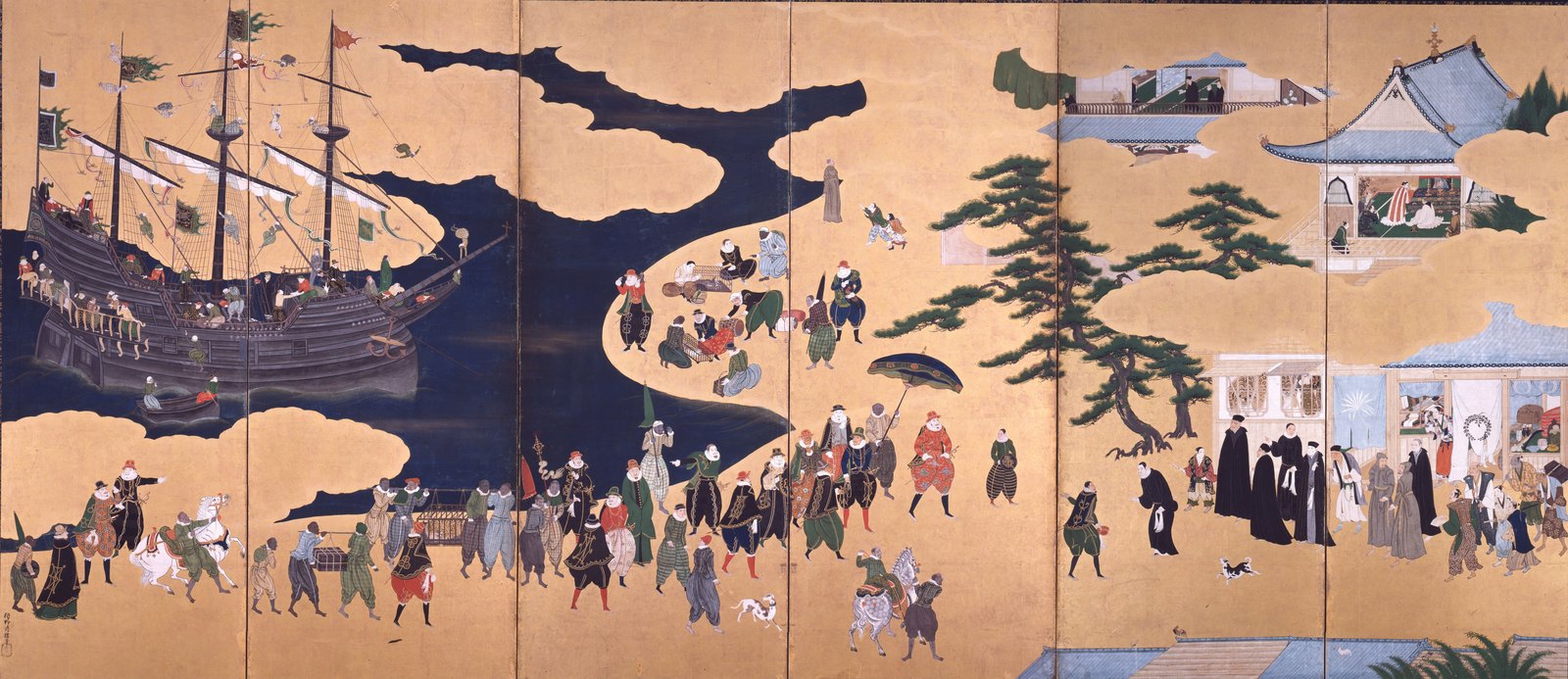
Japanese painters left a picture of what this looked like from the outside. On the screens of Kanō Naizen in Kobe City Museum, a Portuguese ship unloads at a Japanese port; the captain's party is met by Jesuit missionaries, Franciscan friars and Japanese believers; behind a shop selling tiger skins, silk and ceramics stands a church with a curved temple roof, where a priest raises the host before an altar. Kobe City Museum says the screens show the real nature of the Nanban trade, in which commerce and mission were bound together.
That is the chapter in one image: the ship and the church in the same street, and at the centre of the picture a priest raising the host.
The turn
The first blow came from the man who had unified Japan. suddenly ordered all foreign missionaries to leave. A notice to his retainers, dated 23 July and addressed to the Hakozaki district of Hakata, came first. The public decree followed on 24 July. It opens: "Japan is the Land of the Gods." The missionaries were given twenty days to leave, but the trade of the Black Ships, it said, "is a different matter." why he turned is argued over; historians offer several reasons. He took Nagasaki under his direct control. The order was not strictly enforced, but it pushed the missionaries out of public view.
Then came new missionaries, and new danger. Spanish Franciscans arrived from Manila in 1593 and preached openly, arguing that the expulsion order applied only to the Jesuits. In 1596 the Spanish ship San Felipe was wrecked on Shikoku, and Hideyoshi, seizing its cargo, renewed his order and had the leaders of the Christians in Kyoto and Osaka arrested. Twenty-four were paraded through Kyoto, Osaka and Sakai with their ears cut, two more joined them on the road, and on 5 February 1597 all twenty-six were crucified at in Nagasaki. On their last morning they walked the old road through Urakami into the city.
The last growth, and the end
Hideyoshi died the next year, and for a decade the new ruler, Tokugawa Ieyasu, took no firm line. Miyazaki calls it the Christians' last period of growth. But the world was changing. In 1600 the Dutch ship De Liefde reached Bungo with the Englishman William Adams aboard; the Dutch opened a trading post at Hirado in 1609 and the English in 1613. Portugal and Spain had pursued trade and mission as a unit; Protestant England and Holland came for trade alone. Once their trade mattered more, Miyazaki writes, there was no further diplomatic need to put up with the Christians.
In 1614 the shogunate banned Christianity throughout Japan. Every church and monastery was destroyed. More than 350 people, missionaries and leading Christians such as Takayama Ukon among them, were deported to Macao and Manila. Of 115 Jesuits in Japan, 89 were exiled; the rest went into hiding.
The faith had come with the ships, and when the ships changed it was outlawed. What happened next depended on the people who had received it, and on whether, as Anjirō had said in Malacca, they had found it worth keeping.