Coming home with nothing
In 1873 the ban on Christianity was lifted and the exiles of Urakami came home. More than 3,000 had been sent away in the "journey" (旅) of 1867-1873; 613 died before they could return, according to the Japan Tourism Agency text; Nagasaki City gives about 660. 1,2 Disputedfigure. They found no houses and no property. What they wanted first, Nagasaki City's history says, was a house of God. 2
They bought the site of the old village headman's house, the place where they had been forced to step on fumi-e, and in 1880 repaired it as a temporary church. 3,2 By the late 1880s more than 5,000 believers were spilling out of its doors at Sunday Mass. 4
A priest who drew his own plans
In September 1888 Father Pierre-Théodore Fraineau (フレノ神父, 1847-1911) of the Paris Foreign Missions Society became parish priest. He came from a family of stonemasons and carpenters and had arrived in Nagasaki in 1873. 2 He drew the design himself: a pure Romanesque church of stone and brick with a great central dome. 4,2
He collected it in small coins. Every month, on set days, Fraineau walked the districts of Urakami with a satchel. Children ran ahead shouting that the priest was coming, and families brought 5 or 10 sen, which he noted in a book. When enough was saved, stone and brick were bought; when they were landed at the Doi pier, believers competed to carry them up Takaya hill as volunteer labor. 4 Help came from friends in France and from sailors on ships in port; a French naval officer named Maurice gave a large part of his inheritance. 4
Thirty years of building
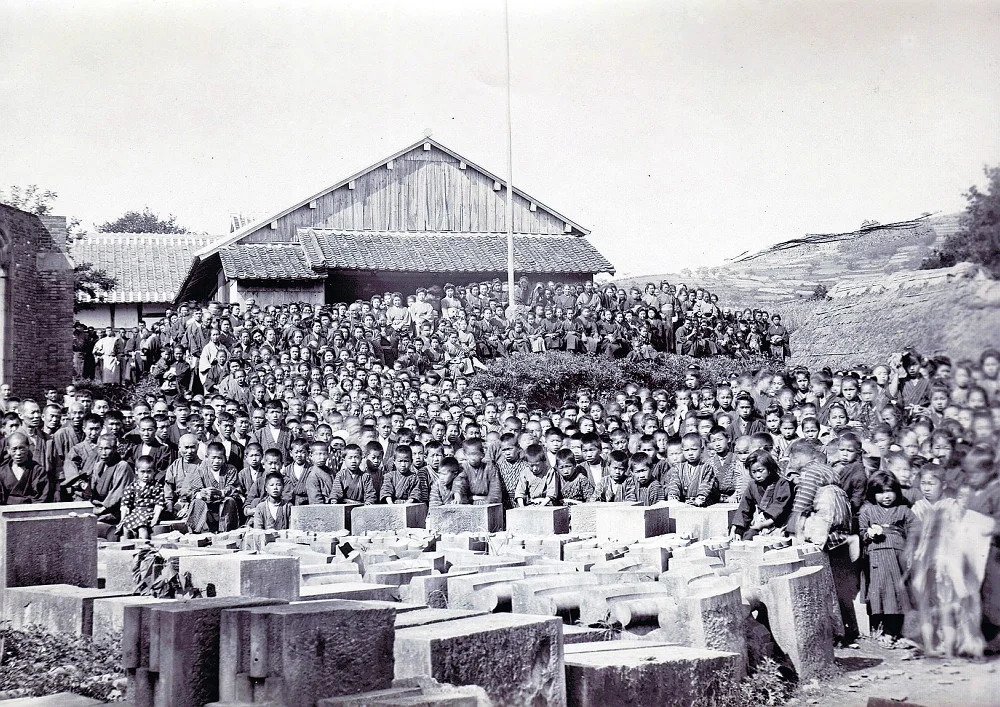
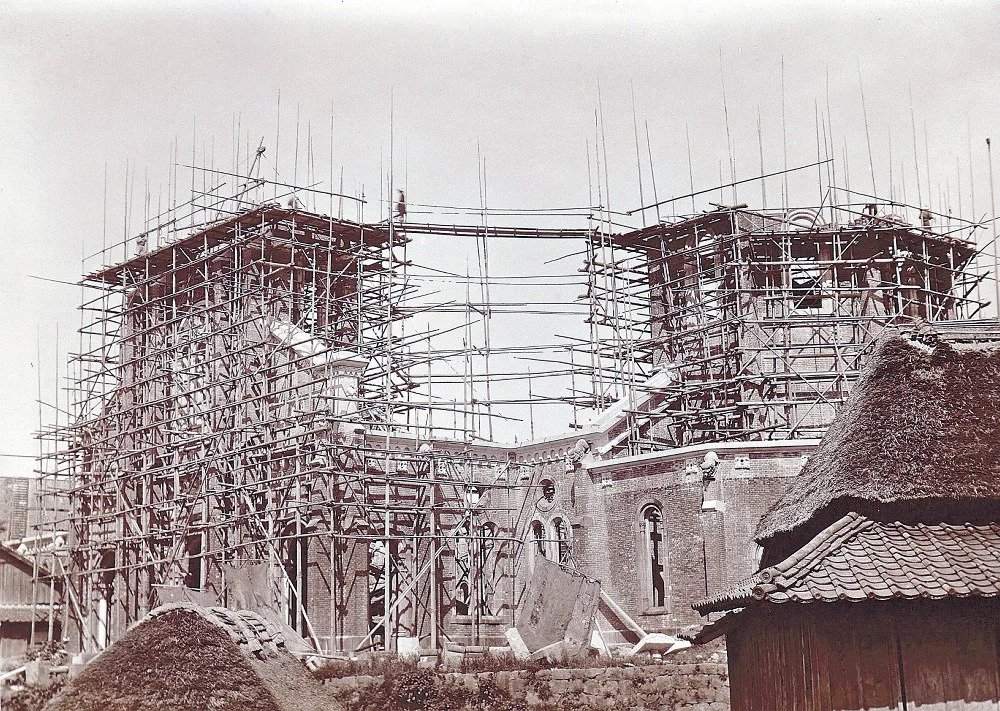
Work began in 1895 under Fraineau's own design and supervision. 4,3 Inflation after the Sino-Japanese War, and worse after the Russo-Japanese War, slowed it; around 1905 it stopped for a time. 4 Fraineau, often ill but, the parish history says, always acting as if nothing were wrong, gave his own money and lived in extreme poverty for sixteen years of building. He died of overwork on 24 January 1911, aged 64, after 38 years in Japan. 4,2 Two photographs from the Paris Foreign Missions archive show this stage: Sunday Mass among the half-built walls in 1911, and scaffolding in September 1912. 7
His successor, the Belgian Father Raguet (ラゲ神父), saw the crowd outside the temporary church grow every year at each Mass and decided the work could not wait. He changed the plan to finish faster: no central dome, and an upper structure of wood with a tiled roof. 4,2 The church was dedicated to the Immaculate Conception. DisputedNagasaki City and the hypocenter-park plaque give 1914 (Taishō 3) for the dedication; the parish history gives 18 March 1915, the day after the 50th anniversary of the Discovery. 3,5,4
The building that rose was cross-shaped, about 1,162 m² in area, 20 to 29 m wide and 50 m long, of stone and brick except for its upper part. 4 Its front had a Romanesque-style arched entrance, columns of white marble in the Ionic manner, and walls of red brick. 4 On its eaves stood 84 half-length angels, 33 lions and 14 stone saints. The parish history says Fraineau called in Jizō carvers from around Japan, but most left within days, saying they could not carve foreign faces; only one stone carver from Amakusa stayed. Traditionparish account. 4
Last came the towers. Under Father Hugues (ヒューゼ師, romanization to confirm) believers built twin bell towers 25 m high in about a year, finished in 1925, thirty years after the first stone. They held a large and a small bell from France. On great feasts such as Christmas and Easter both rang together, and the parish remembers their long resonance as sounding like a message from God. 4,2
What was inside
The parish history remembers a 75 kg sanctuary lamp given by the papal delegate, statues of the Sacred Heart and Holy Family from Belgium, and stained glass of Mary with Peter and Paul. Above the main altar stood a wooden statue of the Immaculate Conception, said to have come from Spain. 4 Traditionthe parish history says the sculptor Takamura Kōun so admired one of the angels at the Virgin's feet that he "threw down his chisel and sighed" over it. 4 Disputedthe priest who later rescued its burned head remembered it as sent from Italy (see the The Bombed Mary of Urakami (Hibaku no Maria) page). 8 Beside the front stood a persimmon tree at the old entrance of the headman's house. Traditionthe ancestors were tied to this tree during interrogations. 4
People called it the largest church in the East (東洋一). 3 Notethis was a popular boast, not a measured claim.
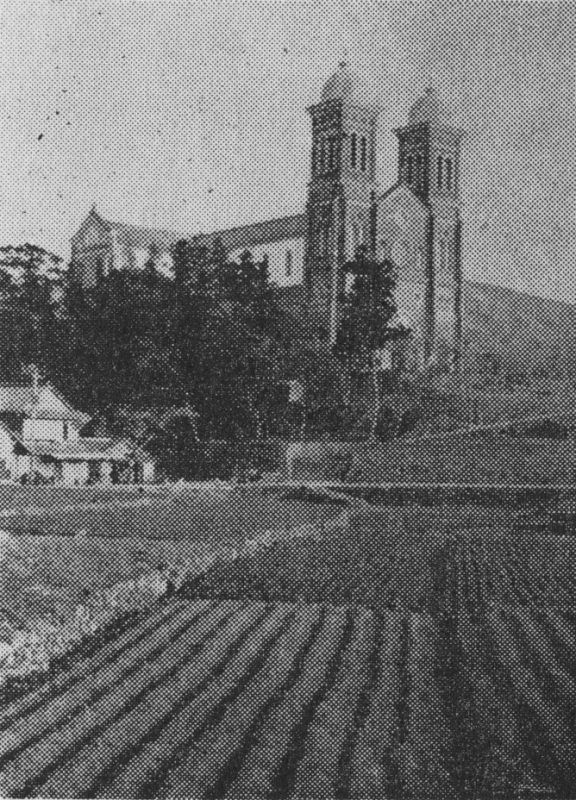
Slide 8 shows the finished cathedral, twin towers and all, between 1925 and 1945. 6 It stood for twenty years. On 9 August 1945 it was about 500 m from the hypocenter. 5