十Christian Japan
Place guide · Nagasaki · Church

Urakami Cathedral

The returned exiles of Urakami bought the house where their families had been made to tread on images of Christ, and built their church on it. Why there, and what happened to it in 1945?

5 min read13 sources8 pinsVisitingTap any name, place or term to learn moreTimeline

A church of reparation on the most painful ground in Urakami. Bought in 1880, raised over thirty years, destroyed by the atomic bomb in 1945 and rebuilt in 1959, it carries the whole story of the village: the treading, the exile, the bomb and the return.

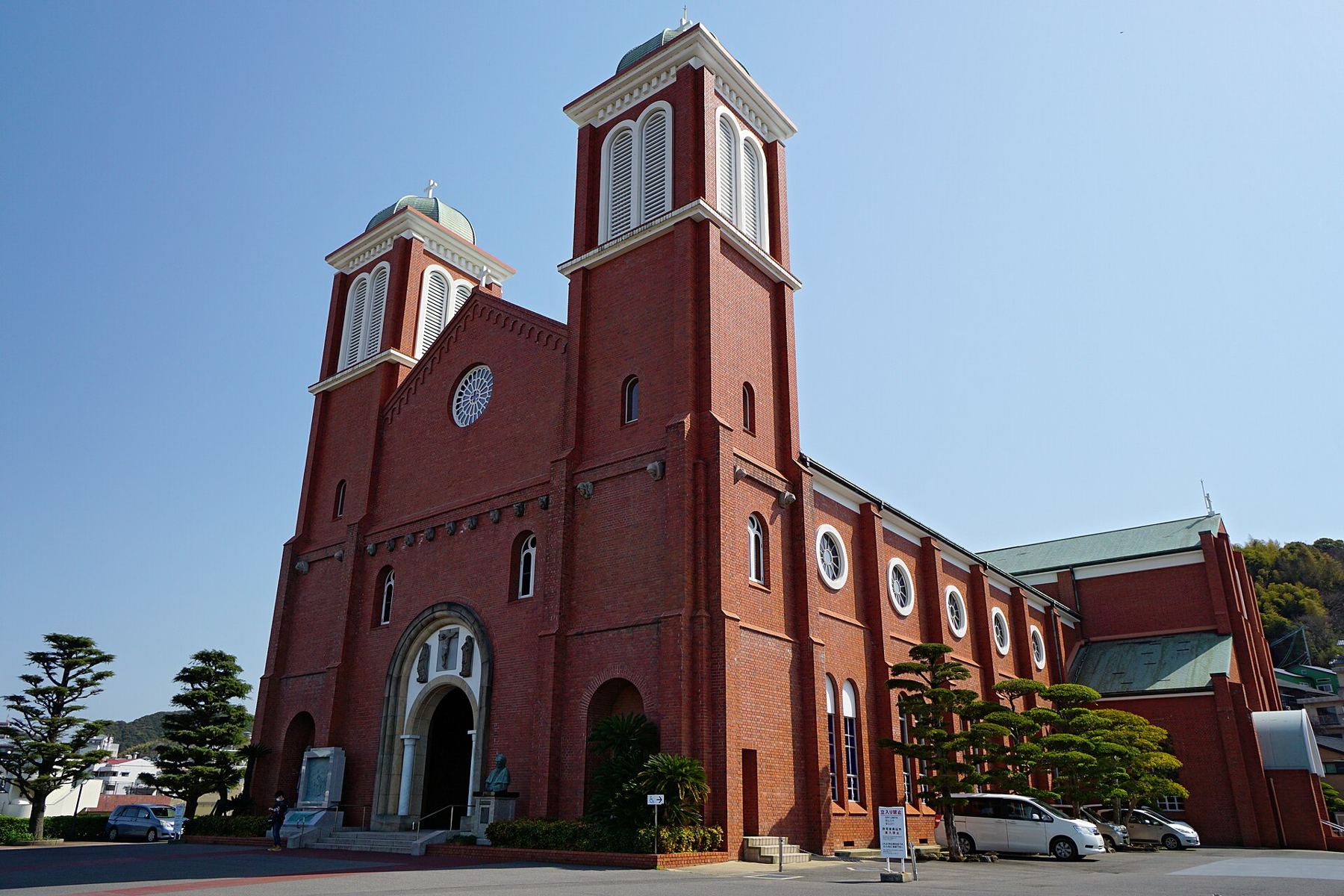
Urakami Cathedral, a red brick church with twin towers
Urakami Cathedral, a red brick church with twin towers.Urakami Cathedral, 21 March 2020. 663highland, CC BY 2.5. Commons

In 60 seconds

The place in 8 steps. Each line is footnoted.

  1. 1880The returned exiles buy the old headman's house, where the New Year treading had been held, for 1,600 yen.
  2. 1895Work begins on a stone and brick church designed by Father Fraineau.
  3. 1914 to 1915The church is completed and dedicated, still without its towers.
  4. 1925The twin towers are finished, with two French bells.
  5. 1945The atomic bomb destroys the cathedral and kills the priests and people inside.
  6. 1959A new cathedral in reinforced concrete is consecrated.
  7. 1980It is faced in brick before the visit of Pope John Paul II.
  8. 2025A copy of the lost small bell rings for the first time on 9 August.

Sixteen hundred yen

On 4 June 1880, the feast of the Sacred Heart, the Catholics of Urakami signed a contract to buy a house. The price was 1,600 yen.

It had belonged to the family, the hereditary headmen of the village. For two and a half centuries the Takaya had helped the magistrate's men arrest and question Urakami's hidden Christians, and every New Year they summoned the villagers to this house to tread on the . When the whole village was sent into exile in 1869, the sentences were read out here. After the Meiji reforms ended hereditary office, the family fell on hard times and sold everything.

On 15 August 1880 the first Mass was said in the old headman's house, now a temporary church. The parish history calls it the place where they had trodden on the images against their will, saying the prayer of contrition as they did it.

Sources: sixteen hundred yen

Most of the detail from 1879 to 1962 comes from the parish's own history of the cathedral, a single institutional source. The Japan Tourism Agency's commentary and the prefecture's heritage site confirm the outline: the headman's site, the dates of building, the bomb and the rebuilding.

On the mapThe headman's ground
Urakami Cathedral, Jūjiyama, San Francisco Xavier chapel site. Full atlas and pin sources
1873 to 1881

A church in a boathouse

The exiles who came home in 1873 had no church. The four secret chapels of 1865 to 1867 had been destroyed, and to hear Mass they walked to . In 1879 a returned exile, Aikawa Chūemon, arranged with Father Poirier, Urakami's first parish priest, to turn a room of his brother's house at Doi, the boat landing on the Urakami River, into a chapel of St John the Baptist. It held about 200 people.

The headman's house replaced it in 1880. The next year the returned exiles raised a cross on a nearby hill, , in reparation for the treading and in thanks that the persecution was over.

On the mapThe walk to Ōura
Urakami Cathedral, Jūjiyama, Ōura Cathedral. Full atlas and pin sources
1888 to 1925

The money will come down from heaven

By the late 1880s the old house was rotting, and on Sundays a congregation of more than 5,000 overflowed into the yard. In September 1888 Father Pierre-Théodore became parish priest and resolved to build a real church on the headman's ground. When he showed the plans to Bishop Cousin, the parish history says, the bishop asked where the money would come from. Fraineau answered that it would come down from heaven.

It came slowly. Fraineau went round the hamlets each month with a satchel, and families brought five or ten sen at a time. When stone and brick arrived at the Doi landing, parishioners competed to carry them up the hill. Work began in 1895. Fraineau died on 24 January 1911, aged sixty-four, before it was finished. His successor, Émile of the Paris Foreign Missions, simplified the design: no central dome, and an upper structure of timber and tile.

The church was dedicated to the Immaculate Conception. the parish history gives completion in 1914 and the on 18 March 1915; the Japan Tourism Agency and the prefecture give the consecration as 1914. The two front towers, 25 metres high, were finished in 1925 and held two French bells. People called it the largest church in East Asia. Unverified as a ranking: the parish says "it was said", and the tourism text says "one of the largest churches in Asia".

9 August 1945

A few hundred metres from the hypocentre

At 11:02 on 9 August 1945 the atomic bomb exploded over Matsuyama-machi, a few hundred metres from the cathedral. Confessions were being heard before the feast of the Assumption. The parish priest, Father Nishida Saburō, and his assistant, Father Tamaya Fusakichi, were killed with the parishioners inside when the church collapsed and burned.

The right-hand tower fell straight down. The left-hand belfry, about ten tonnes, fell almost whole into the stream beside the church, where it still lies. Of the 84 angels, 33 lions and 14 saints on the building, only about twenty angels, two or three lions and three saints survived. The large bell came through almost unharmed; the small bell was smashed.

On 23 November 1945 about 600 surviving parishioners gathered before the ruins for a requiem, and read a eulogy. On Christmas Eve the big bell, dug from the rubble, was hung from three lashed logs and rang again over Urakami.

On the mapThe bomb and Urakami
Urakami Cathedral, St Francis Hospital, Hypocenter Monument, Nyokodō. Full atlas and pin sources
1946 to 1981

Rebuilding

In 1946 the parishioners, nearly all of them bomb victims or repatriates, cut timber from the burned hills and built a wooden church, blessed on 1 December 1946. The fallen belfry was too heavy to move, so the parish moved the stream instead.

The parish decided that rebuilding meant building as before, and that the surviving ruins had to go. The city's committee for atomic bomb remains asked for them to be kept, but the parish would not give up the headman's ground. Part of a side wall was moved to the hypocentre instead. The new cathedral in reinforced concrete was consecrated on 1 November 1959, and on 1 January 1962 it became the cathedral of the diocese in place of Ōura. Relics of three of the Twenty-Six Martyrs were placed in its main altar.

For twenty years it was bare grey concrete. Before Pope John Paul II's visit it was faced in 1980 with brick tiles, given stained glass and a rose window. On 25 February 1981 the Pope ordained priests here.

Today

Two bells again

The cathedral seats a thousand. The fallen belfry still lies in the stream to the left of the church, and burned statues from the old façade stand beside the path. In the garden is the Torture Stone from , where Urakami exiles were made to sit until they died or gave up their faith.

In 2025 Catholics in the United States had a copy of the lost small bell made. It was blessed on 17 July 2025 and rang for the first time at 11:02 on 9 August 2025, eighty years after the bomb, together with the bell that survived.

Timeline

The dated story

Every dated event on this page, with its sources. Filter by section.

  1. 1869Exile sentences read at the Takaya house
  2. 1879Chapel of St John the Baptist at Doi
  3. 4 Jun 1880Takaya estate bought for 1,600 yen
  4. 15 Aug 1880First Mass in the headman's house
  5. 1881Cross raised on Jūjiyama
  6. Sep 1888Fraineau becomes parish priest
  7. 1895Construction of the cathedral begins
  8. 24 Jan 1911Fraineau dies
  9. 1914Church completed (consecrated per JTA; Disputed)
  10. 18 Mar 1915Dedicated to the Immaculate Conception (parish; Disputed)
  11. 1925Twin towers completed
  12. 9 Aug 1945Destroyed by the atomic bomb
  13. 23 Nov 1945Requiem before the ruins
  14. 24 Dec 1945The surviving bell rings
  15. 1 Dec 1946Wooden church blessed
  16. 1 Nov 1959New cathedral consecrated
  17. 1 Jan 1962Becomes the cathedral of the diocese
  18. 1980Brick facing and stained glass
  19. 25 Feb 1981John Paul II ordains priests here
  20. 9 Aug 2025The restored small bell rings
Atlas

Where it happened

Each pin is a place named on this page. Coordinates come from official prefecture maps, OpenStreetMap or Wikidata, as listed. Rows marked "not yet pinned" have no verified pin.

This placeRelated site
PlaceWhy it matters hereCoordinatesCoordinate source
Urakami CathedralThe former Takaya headman's estate32.7761633, 129.8683892OpenStreetMap way/280652259
Fallen belfryIn the stream to the left of the churchbeside the cathedral, not separately pinnednot yet pinned
Doi chapel siteThe 1879 chapel by the Urakami Riverlocation not foundnot yet pinned
JūjiyamaCross of 188132.7853288, 129.876178OpenStreetMap way/812874963
St Francis HospitalMass said here after the bomb32.783292, 129.8733641OpenStreetMap way/184510420
Hypocenter MonumentPart of the old cathedral wall was moved here32.7737573, 129.8632372OpenStreetMap way/375933470
NyokodōNagai Takashi's hut nearby32.7789294, 129.8655691OpenStreetMap node/5761929753
San Francisco Xavier chapel siteOne of the four secret chapels of 186532.7781537, 129.8647386OpenStreetMap node/13974386440
Ōura CathedralWhere Urakami's people walked to Mass32.734189, 129.8701625OpenStreetMap way/243003159
HagiExile site; the Torture Stone came from here34.415695, 131.378204GSI address search for 萩市堀内1番地
Name cards

People, places and events

Who and what this page touches. Dashed cards are pages still to come.

Visiting

If you go

Practical details change. Check with the operators before you travel. Churches are places of worship: please follow the visitor manners asked of you.

Read next

Where to go from here

Glossary

Words on this page

fumi-e 踏絵
An image of Christ or Mary that suspects were made to tread on.
dedication 献堂式
The rite that blesses a new church for worship.
Sources

Footnotes

Translations from Japanese sources are ours.

  1. Urakami Cathedral parish history, "総流配より帰郷後の窮乏" and "仮聖堂の建立," source link (checked 19 Oct 2026)
  2. Urakami Cathedral parish history, "本聖堂の建立," source link (checked 19 Oct 2026)
  3. Japan Tourism Agency, Multilingual Commentary Database, "Urakami Cathedral" (R2-00458), source link
  4. Urakami Cathedral parish history, "原爆被災," source link (checked 19 Oct 2026)
  5. Urakami Cathedral parish history, "平和の建設" and "原爆被災後の復興期," source link (checked 19 Oct 2026)
  6. Urakami Cathedral parish history, "浦上天主堂再建," source link (checked 19 Oct 2026)
  7. Nagasaki Prefecture, おらしょ こころ旅, column "再建した聖堂のお色直し" (text Kawamura Noriko), source link
  8. Urakami Cathedral parish history, "教皇ヨハネ・パウロ二世の訪日," source link (checked 19 Oct 2026)
  9. Archdiocese of Nagasaki, "7月17日 浦上教会に寄贈された鐘の祝福式," 18 Jul 2025, source link
  10. Institut de recherche France-Asie (IRFA), Missions Étrangères de Paris archives, "1404 RAGUET Émile," source link
  11. Nagasaki Prefecture, おらしょ こころ旅, "浦上教会" (registered asset page, glossary, address and access; column "マリア像の数奇な運命"), source link
  12. Nagasaki City Nagai Takashi Memorial Museum, "永井隆記念館概要" (access), source link
  13. Nagasaki Prefecture tourism (ながさき旅ネット), "教会見学時マナーのご案内," source link
The wider story

For the wider story around this place, see Nagasaki: the Christian city.

Images

Image credits