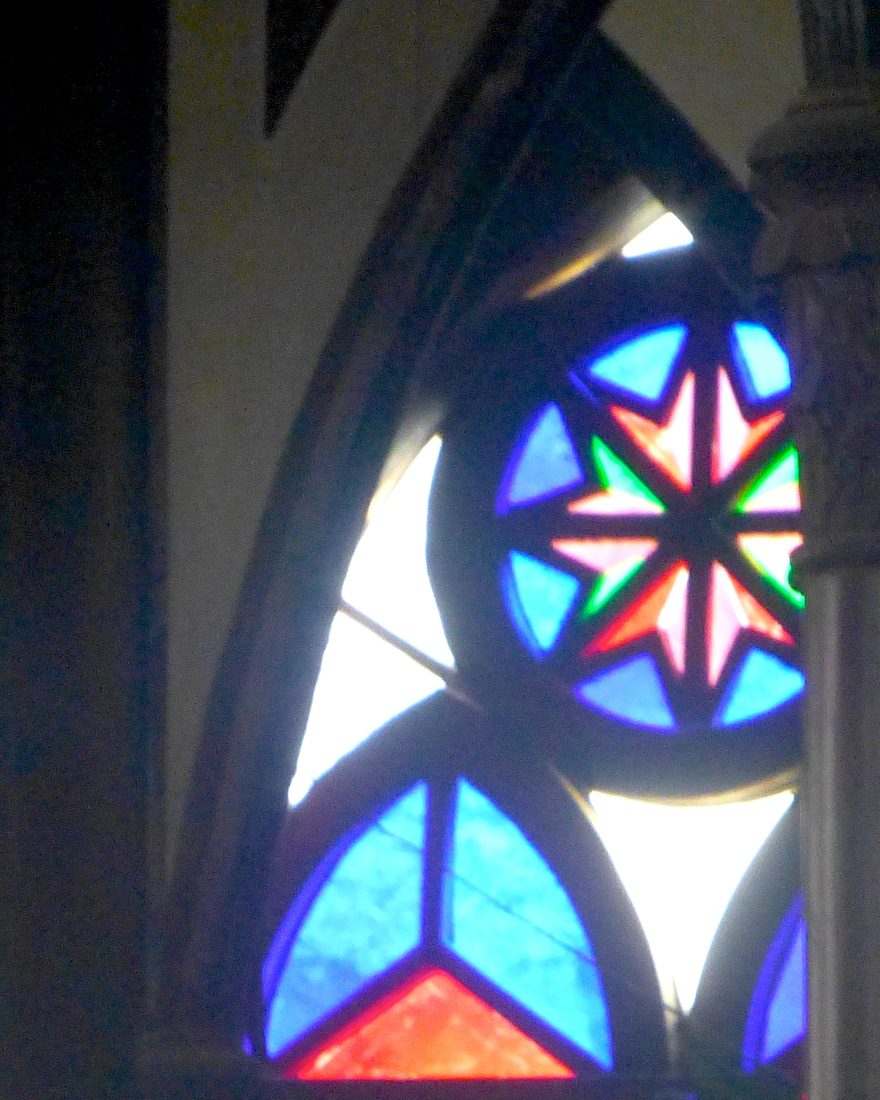
A window from Le Mans
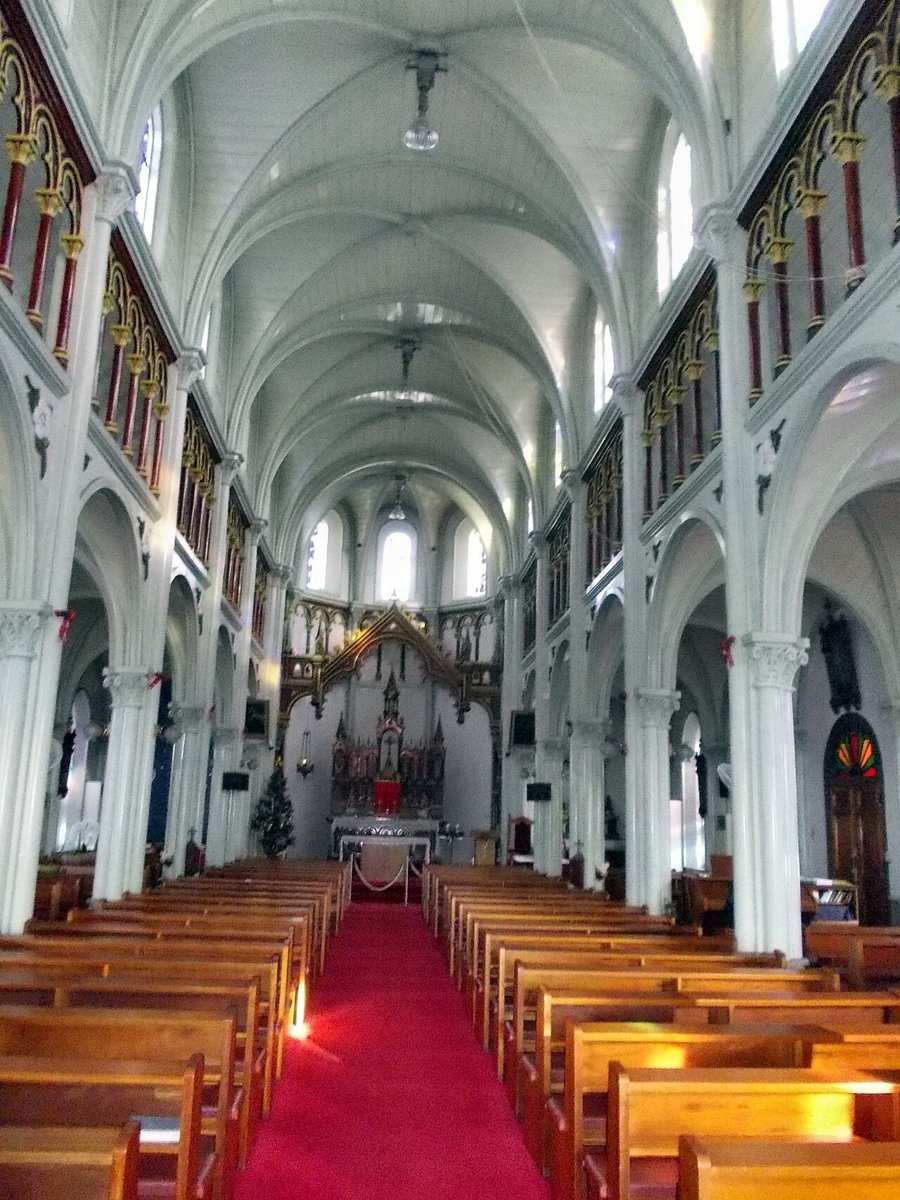
Stand in Ōura Cathedral and look past the altar. The tall window there shows Christ on the cross with Mary on his right and John on his left. 1 It was a gift. When the church was founded in 1865, the Carmelite convent of Le Mans, the home town of Father Louis Furet, sent the window to mark the occasion. 1 Nagasaki City's feature series calls it one of the oldest stained glass windows in Japan, 3 and the Matsumoto Stained Glass company, in its history of the craft, names Ōura as the oldest surviving stained glass in Japan. 5
What hangs there now is not the 1865 glass. On 9 August 1945 the atomic bomb, exploding about 4 km away, smashed the roof, the main doors and the windows. 2,1 Repairs began in 1951. 1 The Archdiocese ordered a replacement from a French firm (named in Japanese as ロジェ商会, Paris), working from surviving fragments and old photographs under the direction of 森政三 (Mori Masazō), a Ministry of Education technician. 6 The restoration was finished on 30 June 1952, and Ōura was re-designated a National Treasure on 31 March 1953. 2
Three generations in one wall
The windows on the sides tell a quieter story. According to the Church Trust guide, the side glass is colored glass that Furet bought through Nagasaki merchants, as recorded in Petitjean's letters; it survived the bomb and is mostly original. 6 The Nagasaki Prefecture column on Ōura's windows is more cautious: three kinds of glass are mixed there, most of it made for the 1879 rebuilding, with repairs after 1945 and again after a typhoon in 1990. 4 Nagasaki City adds that this is why the reds vary slightly from pane to pane. 3 Disputedhow much of the side glass dates from 1864-65 versus 1879.
The founding church also had a rose window on its front. When the building was enlarged, that rose window was moved; it now sits in the side wall of the southwest chapel and can be seen from outside. 6,7
Japan learns to make its own
For its first decades, church glass in Japan was imported. The person usually credited with bringing the craft home is 宇野澤辰雄 (Unosawa Tatsuo, born Yamamoto Tatsuo). In 1886 he went to Germany as a scholarship student and trained in the Berlin studio of Louis Westphal. He came back on 8 January 1890 with cathedral glass and a mill for lead came. His first work made in Japan was for the Tokyo Prefectural Office in 1894 (Meiji 27). 5,8
A family workshop followed. The 宇野澤ステンド硝子工場 (Unosawa Stained Glass Works) was founded in 1906 by 宇野澤辰美 with 別府七郎 (Beppu Shichirō) and 木内慎太郎 (Kiuchi Shintarō); Kiuchi opened an Osaka branch in 1916 that later became 玲光社 (Reikōsha). The works made glass for the National Diet Building in the early Shōwa era and were destroyed in the 1945 Tokyo air raids. In 1948 Matsumoto Saburō, who had trained there, founded 松本ステインドグラス製作所. 5 A second line came from America: 小川三知 (Ogawa Sanchi) is said to have learned American technique in the United States and opened his studio in 1910. Unverifiedthis rests on a secondary blog and needs a primary source. 9
The historian 田辺千代 (Tanabe Chiyo) divides Japanese stained glass into three periods, beginning with a pioneering phase from 1894 to 1910, and notes how much was lost to the 1923 Kantō earthquake, the war and postwar demolition. 10
Flowers on the islands
Out in the villages of Nagasaki and the Gotō Islands, the story is different. These were poor communities of former hidden Christians, and most of their churches were designed and built by the master carpenter Tetsukawa Yosuke (1879-1976), who built more than thirty. 11 A study of Nagasaki's churches lists "floral stained glass" as one of their shared features; the prefecture holds 137 churches, about 13% of Japan's 1,006. 12
Which flower? Gotō City's camellia pages say that camellia is used in the stained glass of several Gotō churches. Traditionthe city phrases this as something that is said (いわれ). 13 At Kashiragashima, a stone church dedicated in 1919, the local guide describes a white camellia motif in the four corners of the interior as a religious abstraction of the camellia. 11 A 2025 paper proposes that the floral reliefs in Tetsukawa's lost church at Hosoishinagare on Hisaka Island were camellias, symbols of martyrdom and paradise, influenced by Father de Rotz. Unverifiedthe author presents it as a hypothesis. 14
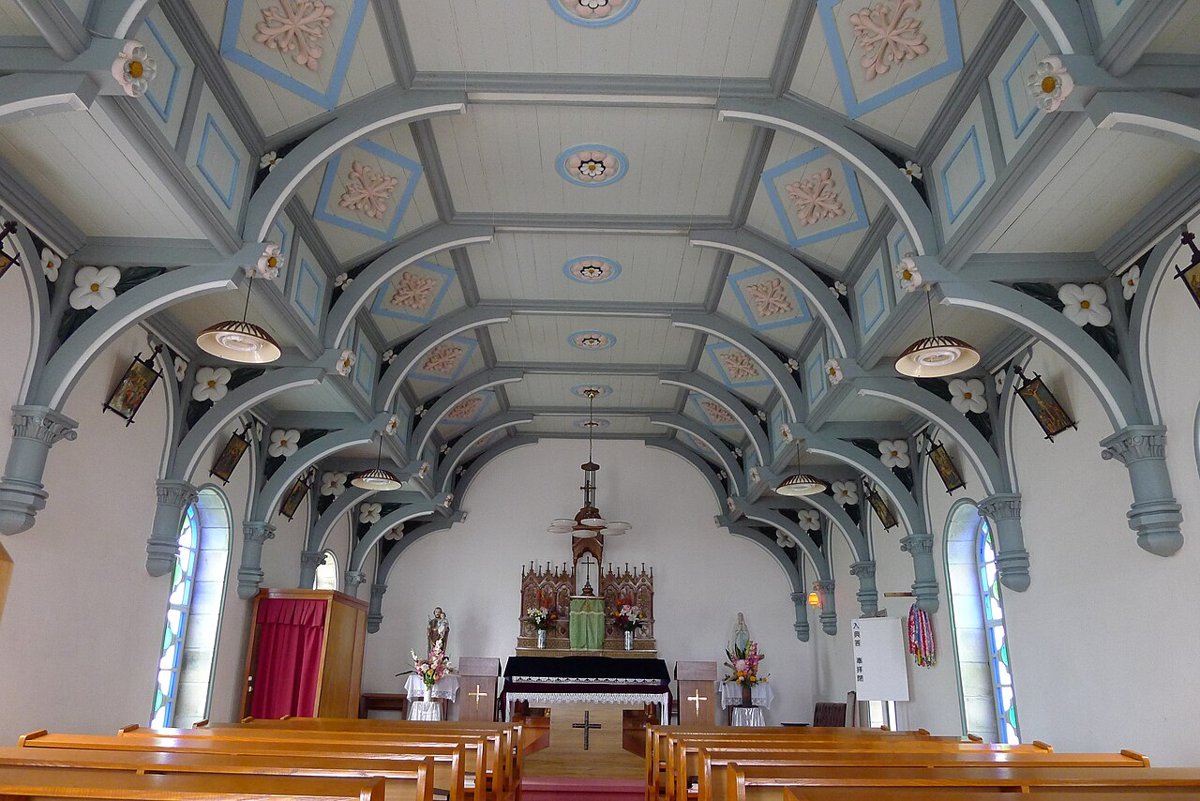
But not every flower is a camellia. At Ōso church, also by Tetsukawa, the prefecture's column describes the original glass as a cherry-like floral pattern, with frosted glass set behind the flowers so that colored light does not fall on the pages of a book; the glass above the altar is West German. 15 At Egami on Naru Island, finished in 1918, there is no true stained glass at all: believers painted cherry blossoms by hand on clear window glass. 16,17
Glass made from what there was
The most moving example is the smallest. The former Gorin church on Hisaka Island has no stained glass. The cross pattern above its door is colored cellophane pressed between two sheets of clear glass. Its side windows once held watercolor paintings sandwiched the same way; examples are kept at the Gotō History Museum. 17 The prefecture's column says it plainly: with little money and little technique, people did what they could to make their church beautiful. 17
Glass after the bomb
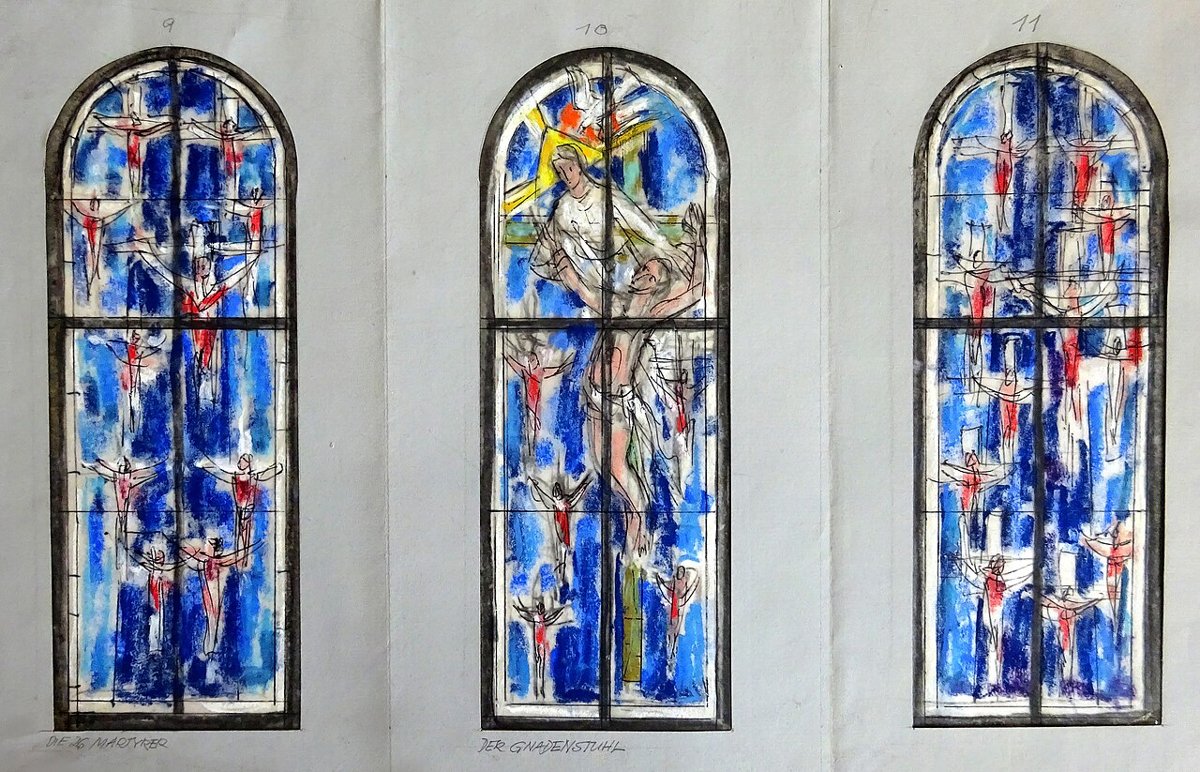
After 1945 the glass came back, often from abroad. At Tabira, the settlers marked the hundredth year since their arrival in 1986 by ordering new windows from Germany and Italy. The upper windows, installed in 1989, are by a German firm (イーゼル社 in Japanese sources) and show the 26 Martyrs above the altar; the lower windows, by an Italian firm, followed in 1998. The original glass was remade and reused at Sakuramachi church in Takamatsu. 18 A Commons file holds 1988-89 design sketches by the German glass artist Maximilian Bartosz labelled for Tabira. Unverifiedwe have not confirmed how these sketches relate to the installed windows. 19
In Nagasaki itself, rebuilt Urakami Cathedral (1959) had plain windows until 1980, when every window was changed to stained glass, with a five-color rose window on the front, ahead of Pope John Paul II's visit. 20 Inside, the glass shows 24 scenes from the life of Christ. 21 In the chapel of the bombed Mary, a later window designed by Sister 佐藤ヒロ子 (Satō Hiroko) uses lilies and the ruined old church, with half-melted kiln-fired glass for its bricks. It was made by Ikuta Glass in Osaka. 22
What makes it distinctive
The sources point to three patterns rather than a single "Japanese style". First, flowers: floral designs, read as camellia or cherry, recur in village churches. 12,13,15,16 Second, improvisation: where imported glass was unaffordable, believers painted or layered their own. 16,17 Third, layering of loss: Ōura, Urakami and Tabira all hold glass from more than one era, replaced after the bomb, typhoons or anniversaries. 4,18,20 The light in slide 2 has passed through many hands.